


🅿️ Parking in Denmark 2026: how much it costs, where the traps are, and how to pay without stress
There are two types of road‑trippers in Denmark. The first group budgets for bridges, fuel and ferries — and then gets hit by parking. The second group trusts that “Scandinavia is orderly, we’ll figure it out on the spot”… and ends up with an unpleasant note on the windshield.
✅ The good news: parking in Denmark is logical.
⚠️ The bad news: it’s logical the Danish way — and that’s where the 2026 traps live: paid Sundays, number‑plate registration even for a “free first hour,” app service fees, and different rules for municipal vs private parking.
This guide explains it “on fingers”: clear definitions, real prices, city examples, and checklists so you can park confidently — whether you’re Danish or visiting.
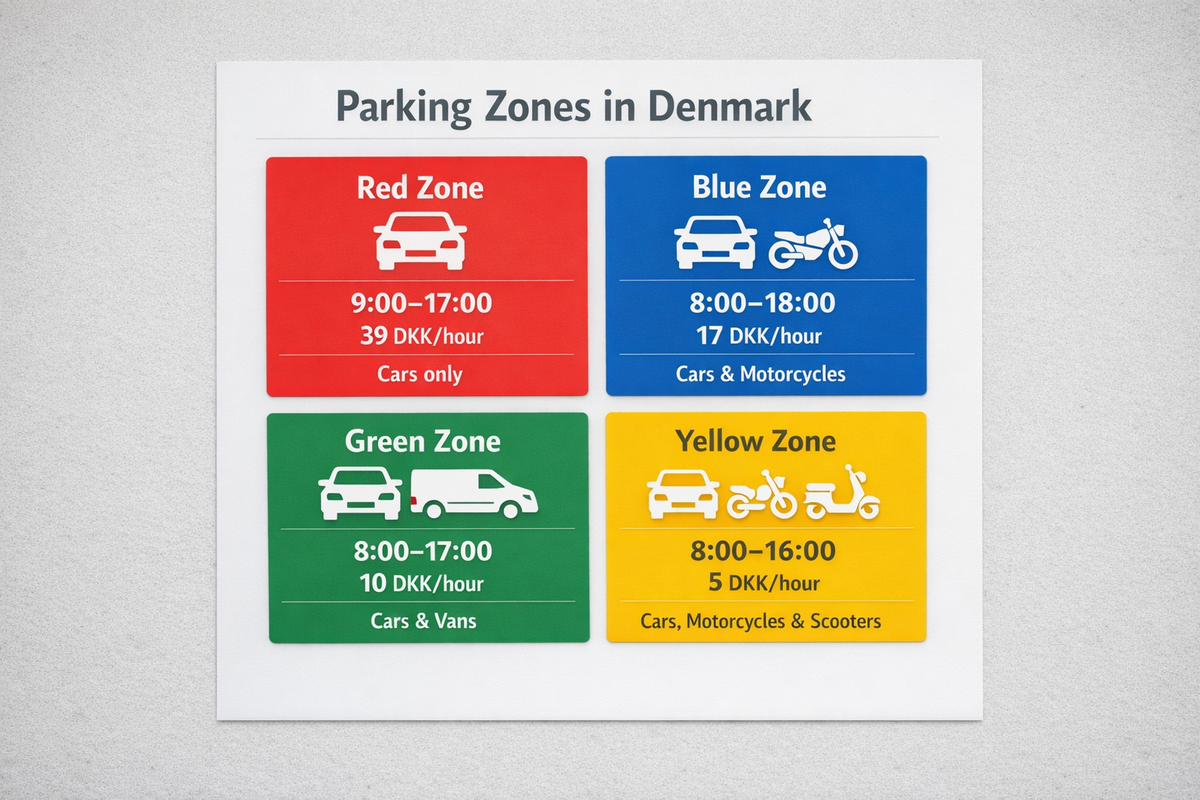
🧭 The key idea: parking in Denmark is either “municipal” or “private”
🏛️ Municipal parking (kommunal parkering)
This is street parking (gadeparkering) and some city garages managed by the municipality.
It usually has:
- clear zones (often color‑coded),
- fixed hourly rates,
- standard fines under public rules.
🏢 Private parking (privat parkering)
This includes parking at shopping centers, supermarkets, offices, some multi‑storey garages, and courtyards.
Rules are set by the owner, so you may see:
- a different payment model,
- different fines/control fees,
- strict conditions like “register your plate at a terminal inside the store.”
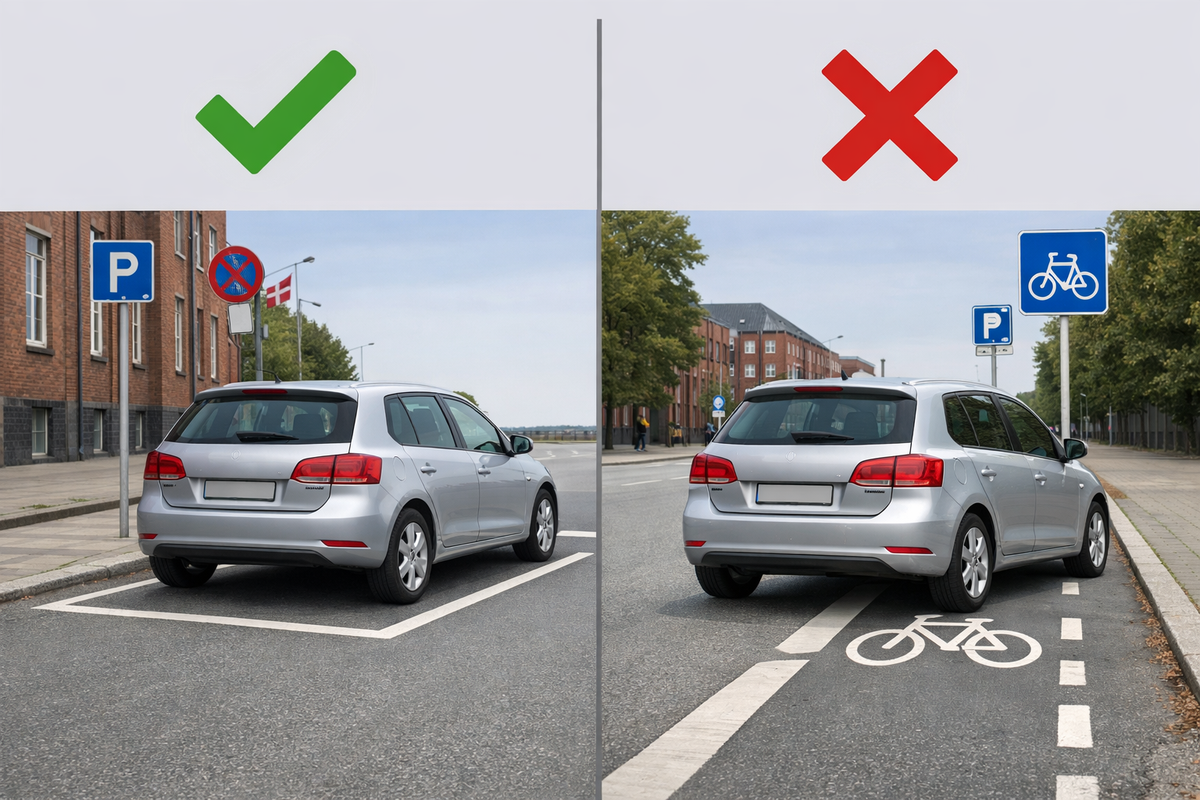
👉 The golden rule: always read the sign at the entrance. In Denmark, it’s essentially a “contract on a board.”
🪧 How to read Danish parking signs (and avoid the classic traps)
Here’s a practical cheat sheet for the most common words and phrases you’ll see on Danish parking signs.
🪧 Danish parking sign cheat sheet
| What you see | What it means in plain English |
|---|---|
| P Parkering | Parking is allowed — but conditions follow below: time limits, payment, restrictions. |
| Betaling Takst | Paid parking. Look for paid hours and the tariff (hourly / per minute). |
| kl. 08–18 | The time window when the rule applies. Often paid only within these hours. |
| max 1 time max 2 timer | Maximum parking time. Overstay = fine risk even if you paid. |
| P-skive | A parking disc is required (arrival time). In some places this is replaced by digital registration — read the specific sign. |
| Kun for beboere Beboerlicens | Residents only (permit required). Not for tourists, even “just for 10 minutes.” |
| Privat område Kontrol | Private parking with enforcement. Often you must register your plate at a terminal/app — otherwise you can be fined. |
💳 How to pay for parking in Denmark: the 4 most common scenarios
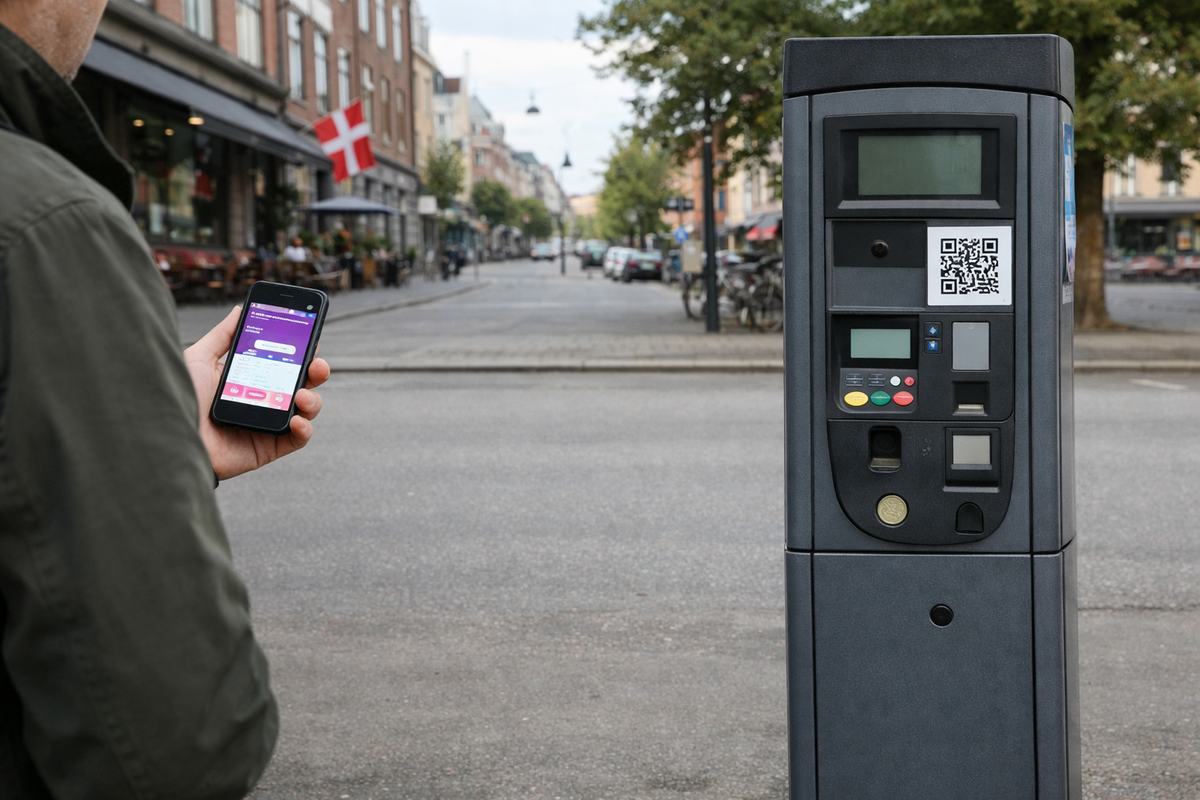
1) 🧾 Parking meter (the most universal option)
In many areas you:
- enter your license plate number (important),
- choose time,
- pay by card.
Pros: predictable.
Cons: you may need to walk to the machine.
2) 📱 Parking app
Convenient because you can:
- start/stop parking,
- extend remotely,
- pay for actual time used.
⚠️ Trap: apps can add service fees (more on that below).
3) 🏢 Multi‑storey garage (parkeringshus / P-hus / P-kælder)
You might see:
- ticket at entry,
- pay before exit,
- license‑plate recognition.
Rules can differ from street parking even in the same city.
4) 🛒 Private parking at supermarkets / malls
A classic Danish “surprise”:
- parking is “free for 1–2 hours,”
- but you must register your plate at a terminal or in an app.
If you don’t, you’re technically breaking the conditions.
🏙️ Copenhagen 2026: zones, paid hours, and prices (simple + numbers)
If you search “parking in Copenhagen price 2026,” you almost always mean the municipal parking zones.
From 1 January 2026, Copenhagen’s baseline municipal street tariffs are:
- Daytime (08:00–18:00) depends on the zone (red/green higher; blue/yellow lower).
- Evening (18:00–23:00) is a single rate across zones.
- Night (23:00–08:00) is cheaper (single rate).
- Paid rules apply every day, with an important “first hour free” window (see table note).
🅿️ Copenhagen: municipal parking prices (from 01.01.2026)
Street tariffs for passenger cars (kommunal betalingsparkering). Always check the sign: private car parks may use different rules.
| Zone | ⏰ 08:00–18:00 | 🌆 18:00–23:00 | 🌙 23:00–08:00 |
|---|---|---|---|
| 🔴 Red / 🟢 Green | 45 DKK/hour | 18 DKK/hour | 6 DKK/hour |
| 🔵 Blue | 26 DKK/hour | 18 DKK/hour | 6 DKK/hour |
| 🟡 Yellow | 17 DKK/hour | 18 DKK/hour | 6 DKK/hour |
⚠️ Copenhagen trap #1: “First hour free” does not mean “do nothing”
In Copenhagen, “free” often still means:
- register the session (plate + start),
- respect the time limit.
🌆 Aarhus, Odense, Aalborg: parking prices in 2026 (and where it’s easier to save)
Denmark does not run on one nationwide parking tariff. Each city has its own zone logic, paid hours, and registration rules.
Below are practical reference ranges for municipal parking (the most searched “parking prices Denmark 2026” layer). Private parking always follows the entrance sign.
🏙️ Quick reference: parking prices in Danish cities (2026)
| City | More expensive / cheaper | Rate (typical) | How to pay | Typical fine |
|---|---|---|---|---|
| Copenhagen | Higher in 🔴/🟢, lower in 🟡. Nights are cheaper everywhere. | Day: 45 / 26 / 17 DKK/hour (by zone). Evening: 18. Night: 6. | Meter / apps / plate number | 510+ DKK |
| Aarhus | City center is higher (red zone). Some “yellow” areas offer 2 hours free (with digital registration). | Red zone: 25 DKK/hour (day), 11 DKK/hour (evening). Sunday: often free. | Often requires digital registration (plate number) | 510+ DKK |
| Odense | 3 zones: red/blue/green. EVs can be cheaper. | Red: 21 DKK/hour (petrol/diesel/hybrid), 17 (EV). Blue: 15/12. Green: 7/5. | Meter/app, plate number required | 510+ DKK |
| Aalborg | Zones: red/yellow/green. Often paid in daytime on weekdays/Sat; evenings/Sun may be softer. | Red: 18 DKK/hour. Yellow: 11. Green: 8. Day passes exist. | Meter/app/plate number | 510+ DKK |
Source notes: Copenhagen tariffs from 01.01.2026 ; Aarhus tariff sheet 2026 ; Odense municipal rates (updated 18.12.2025, valid into early 2026) ; Aalborg municipal zones and rates (updated 08.12.2025) .
🅿️ P+R (Parkér og Rejs): Denmark’s easiest way to save money
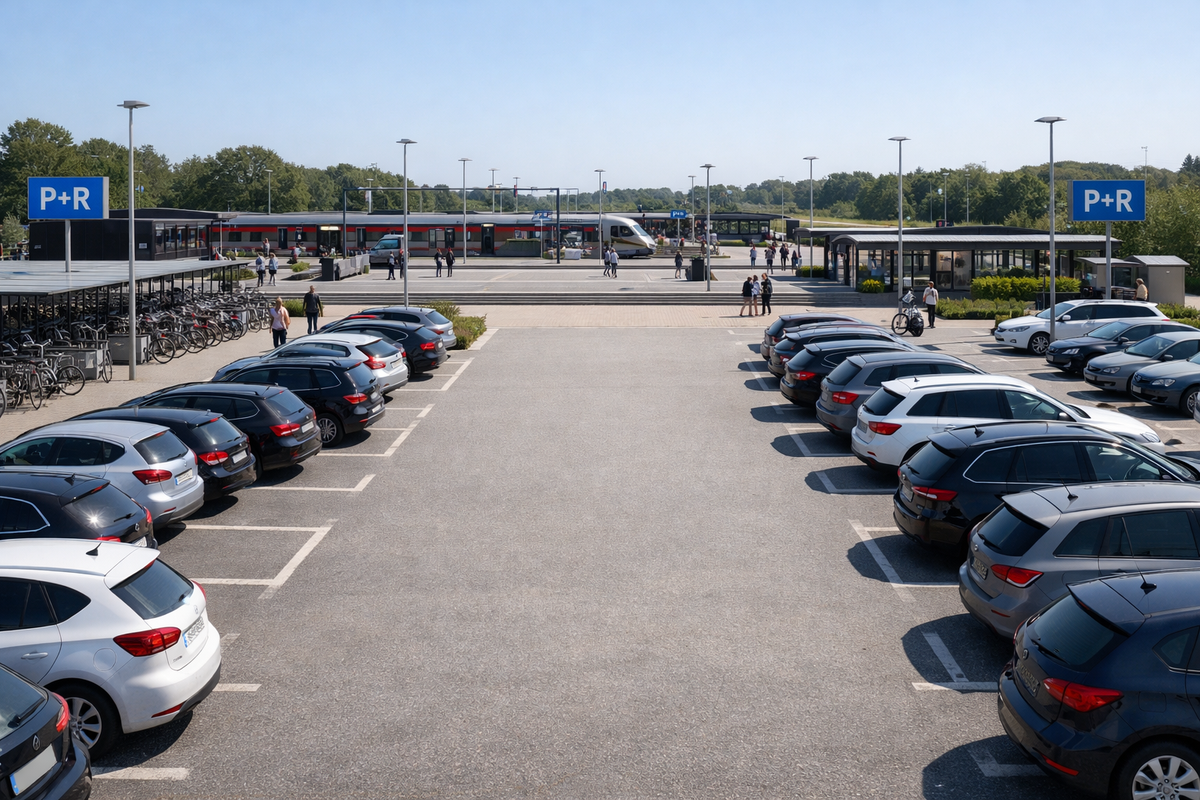
If you’re driving but want to experience the city on foot, P+R (Parkér og Rejs — Park & Ride) is often the smartest approach:
- park the car on the edge of town or near a station,
- switch to metro / train / bus,
- avoid expensive central parking hours.
🚉 P+R in Denmark: how to use it and who it’s for
✅ When P+R is perfect
- You’re staying outside the center but want to walk the center.
- You’re doing a day trip: museums/shopping/Tivoli without stress.
- You have a large car/motorhome and central streets feel tight.
🔎 What to check on site
- The sign: paid or free, and which hours.
- Time limit (max X timer).
- Whether you must register your plate / start a session.
💡 A practical routine
- Park → take a photo of the sign.
- Buy your transit ticket → go into the city.
- Don’t race the clock on the way back — build in buffer time.
💸 “Hidden costs”: why an app can be more expensive than a meter
Parking apps are great… until you realize some of them add service fees on top of the base tariff.
A particularly clear example is Aarhus, which explicitly notes that different apps may add extra fees (percent add‑ons, per‑minute surcharges, start fees).
What to do as a visitor:
- if you want predictability, pay at a meter;
- if you want flexibility, an app is convenient — just check the final total before confirming.
🚫 Typical tourist mistakes (and how not to repeat them)
✅ Checklist before you walk away from the car
- I read the sign at the entrance / at my spot.Not “I saw a P so it’s fine” — but the hours, limits, payment, registration rules.
- I know whether today is paid (weekend / holiday).In Copenhagen people often get surprised by Sunday rules and the “first hour free” window.
- I entered my license plate correctly.Denmark often links payment to the plate. One wrong character can equal a fine.
- I understand the time limit (max X timer) and set a reminder.If there’s a maximum stay, “paying for longer” may not save you.
- I took a photo of the sign and the parking location.Useful in disputes — and simply to remember the conditions and where you left the car.
🧾 Parking fines in Denmark 2026: how much a mistake can cost
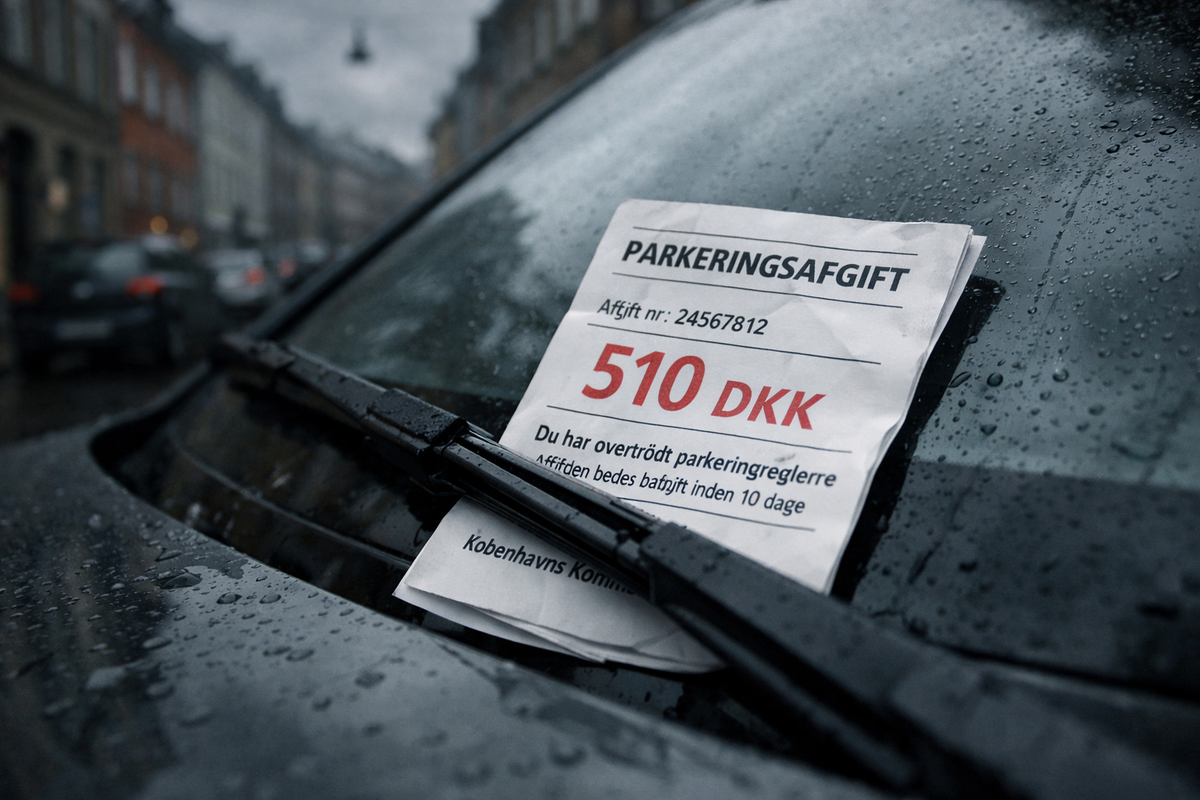
The most common number tourists mean by “parking fine in Denmark” is 510 DKK (a standard municipal parking charge for violations).
But it’s important to know: in “serious” cases it can be higher. For example, certain violations (including parking in a disabled bay without entitlement) can be 1020 DKK, and there are other categories for larger vehicles.
⚠️ One more nuance: private parking areas can use different enforcement fees — the safety key is always the entrance sign.
🧩 Bottom line: how to park in Denmark calmly, like a local
If you reduce everything to one formula:
✅ Read the sign → register your plate → watch the clock → respect zones.
And to save money without stress:
- use P+R (Parkér og Rejs / Park & Ride),
- aim for cheaper zones and night rates where appropriate,
remember: in 2026 the biggest traps aren’t “evil fines,” but small rules tourists skip.
❓FAQ
From 01.01.2026, municipal street rates (08–18) depend on the zone: 45 / 26 / 17 DKK per hour. Evening (18–23) is 18 DKK/hour and night (23–08) is 6 DKK/hour.
Yes — but it’s not “do nothing free.” The first hour free window runs from Saturday 17:00 to Monday 08:00 (and on public holidays), but you still must register the parking session, or you can be fined.
Most commonly you’ll see 510 DKK for a municipal parking violation. Some violations cost more.
Sometimes — if the sign explicitly says “P-skive.” In other areas it may be replaced by digital registration. The sign on site is decisive.
Because some apps add service fees on top of the base tariff (and some cities explicitly warn about it). If you want the cleanest rate, use a meter.
It depends on the city and the area. In the center, both can be costly, but garages can be better for longer stays (and less stress with limits). Always compare the entry sign/rates.
Two things: (1) not reading the full sign; (2) not registering the plate — especially in “seemingly free” supermarket or private lots (or for the “free first hour” window).

0 comments
Log in to leave a comment