


🌠 Where to Stay for the Northern Lights: City with Tours or Cabin in the Dark
Choosing your base is at least 50% of your Northern Lights success. Many travellers fly to Tromsø, Rovaniemi or Abisko, book a hotel in the centre and genuinely expect the green arc to appear over the roof by itself. Others immediately book a cabin “by the lake in the forest” and then discover that without a car and decent road any outing becomes stressful.
This guide will help you realistically decide what works better for you — a city with tours or a remote dark cabin, how many nights to plan and which mistakes to avoid so the trip doesn’t turn into a lottery.
🔬 How to See the Northern Lights at All: What Really Matters
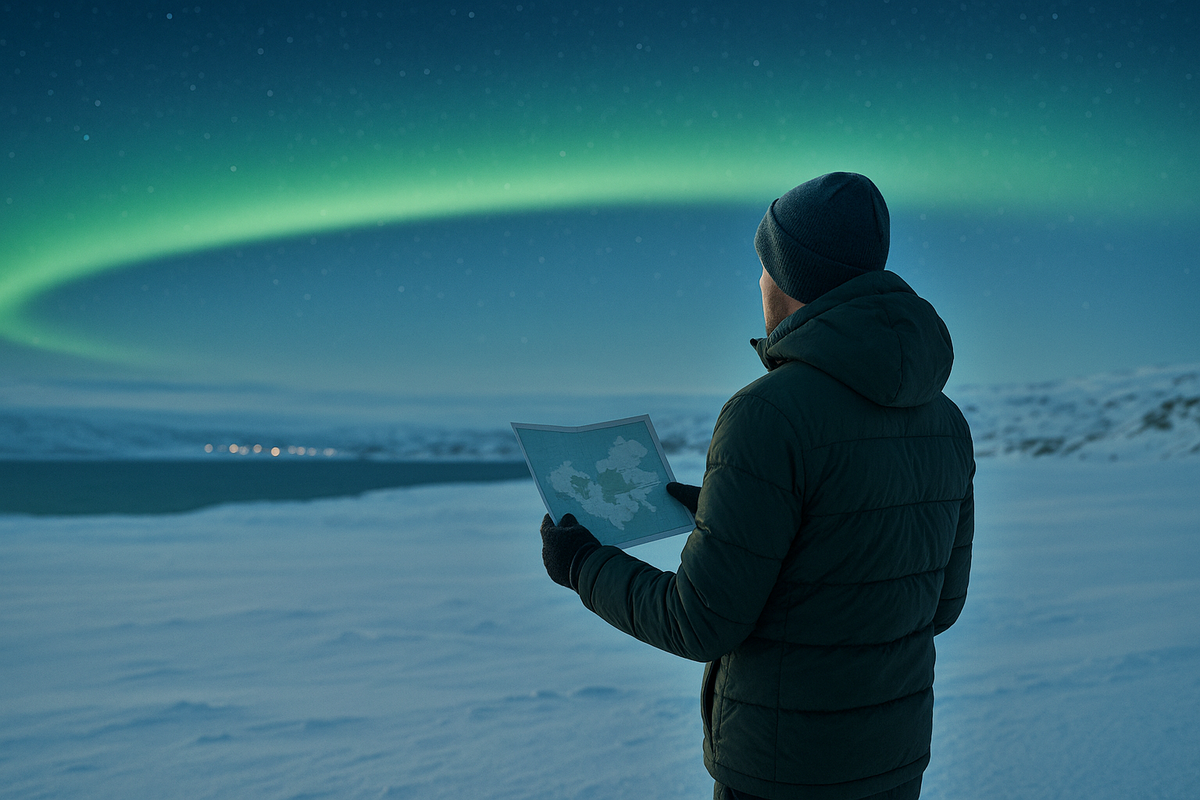
Before arguing “city or wilderness”, it’s important to understand the basics: what physically needs to happen for you to actually see the aurora with your eyes and not just in a forecast app.
💡 Light Pollution
- A bright city “eats” weak aurora: light from street lamps, shop windows and snow makes the sky milky grey.
- Inside big cities you’ll only see very strong aurora events, when the whole sky is literally glowing. It happens, but betting only on this scenario is a recipe for disappointment.
- The less artificial light around and the darker the northern horizon, the higher your chances to see even moderate activity.
☁️ Cloud Cover Matters More Than Kp
- Your main enemy is not low Kp, but solid cloud cover. Even with a strong storm you’ll see nothing through a thick layer.
- You’re looking for “holes” and local clearings: sometimes it’s enough to move 20–50 km to get under a patch of clear sky.
- So you need not only numbers in an app, but an hourly cloud map.
🧭 Orientation and Sky View
- Ideally, your spot should have an open view to the north and a low horizon: lakeshore, open field, plateau.
- Forest or mountains directly to the north can “eat” part of the display low over the horizon.
📈 Kp Forecast: Useful, but Not Magic
- The Kp index shows the overall strength of the geomagnetic storm — the potential brightness.
- But Kp does not guarantee visibility in one specific spot: if clouds cover your location, no Kp will help.
- For a first-timer, the key combo is: region above or near the Arctic Circle + decent weather + dark sky + willingness to go out or drive out of town.
🏙️ City Base: Comfort, Tours and “Chasing the Dark”
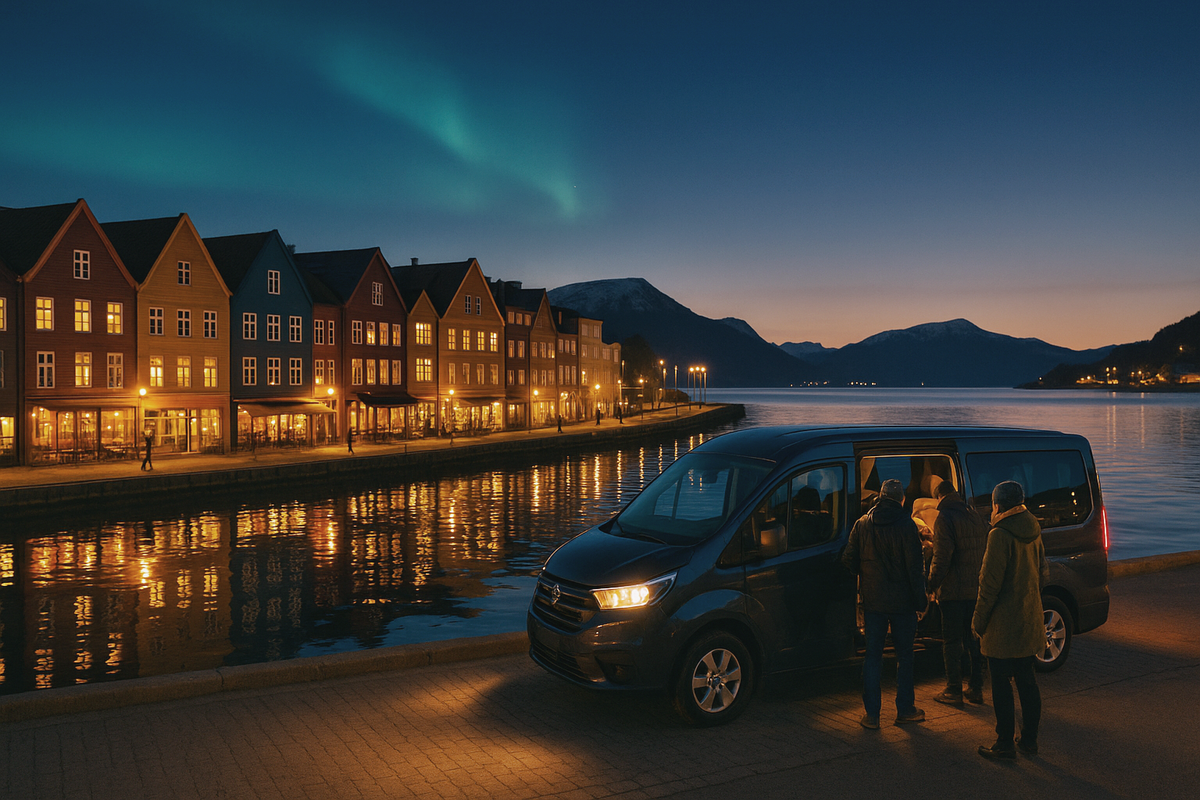
“City” means Tromsø, Rovaniemi, Abisko, and larger cities in Northern Norway, Sweden and Finland. For a first-timer this is the most understandable and manageable scenario.
🎯 Pros of a City Base
- Infrastructure: cafés, restaurants, supermarkets, museums, daytime winter activities.
- Easy logistics: airport → transfer to centre, clear public transport system, taxis, excursions.
- Comfort: heated hotel/apartment, hot shower, a warm place to sit out bad weather.
- Program flexibility: if “tonight will not be fully dark”, you’re not staring at a cabin wall – there’s always something to do.
🚐 Tours as Your Main Northern Lights Tool
With a city base, an organised tour is usually your “ticket to darkness”.
What a tour gives you:
- A drive out of town into dark zones 50–150 km away.
- A guide who knows local spots and tracks clouds.
- Transport, sometimes warm shelters and hot drinks.
- Help with photography, tips on camera settings and where to stand.
Formats:
- Large bus tours – cheaper, but less flexible.
- Mini-bus / small group tours – more expensive, but more mobile and often with more experienced guides.
Private tours – maximum route and pacing flexibility, but also maximum price.
🚕 “Just Drive Out of Town for an Hour”: When It Works and When It Doesn’t
When it works:
- You have a rental car or a reliable local transfer.
- Roads are cleared, weather is stable, no heavy snow or black ice.
- You feel confident driving in winter, at night, in darkness, wind and snow.
When it doesn’t:
- No car, night taxis are rare or non-existent, public transport doesn’t run at the right hours.
- Heavy snowfall, road closures, zero visibility.
- You’ve never driven on ice in complete darkness and are scared, even if you have a car.
🧊 When a City Base Is the Best Option
A city base almost always wins if:
- You only have 3–4 nights.
- You have no experience with winter night driving.
- You want to combine aurora with museums, cafés, and winter activities.
- You’re not mentally ready for complete darkness and silence around a cabin.
In this case the logic is simple: stay in the city, go out on tours, don’t rely on “aurora from your window”, and plan a buffer in nights.
🏡 Cabin in the Dark: Maximum Darkness, Minimum Infrastructure
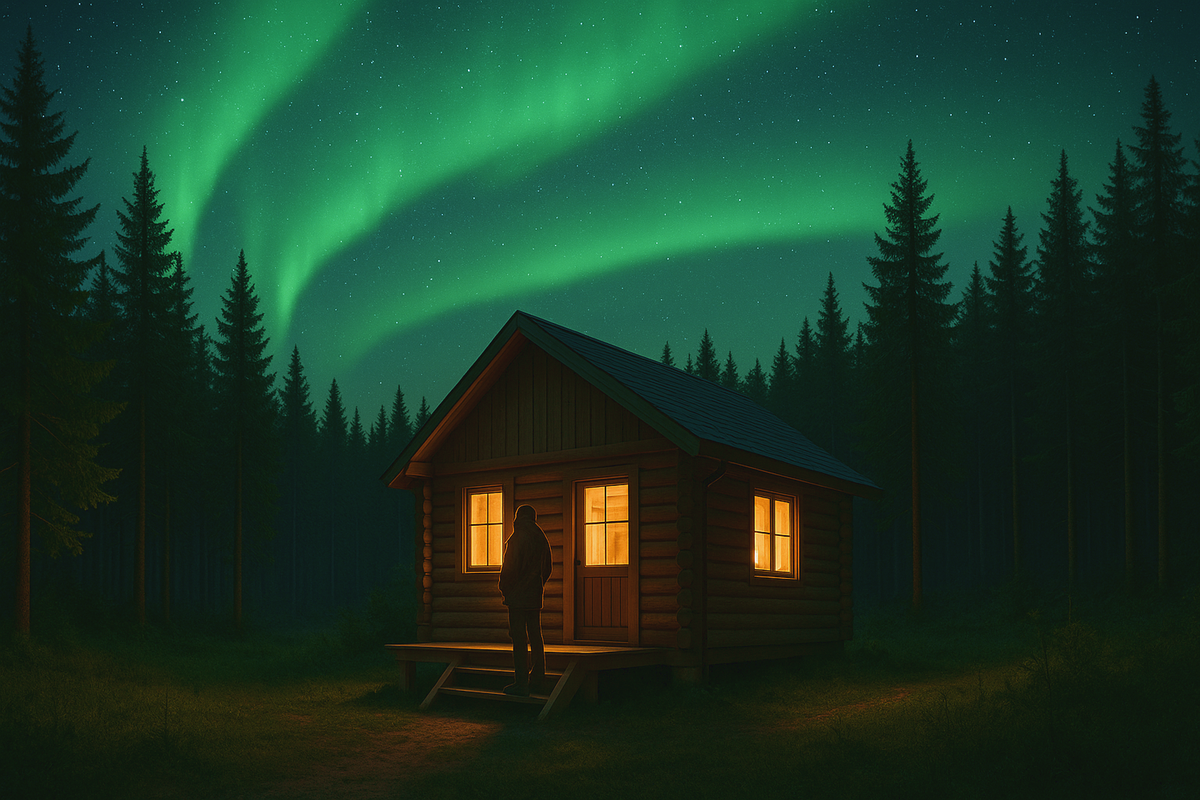
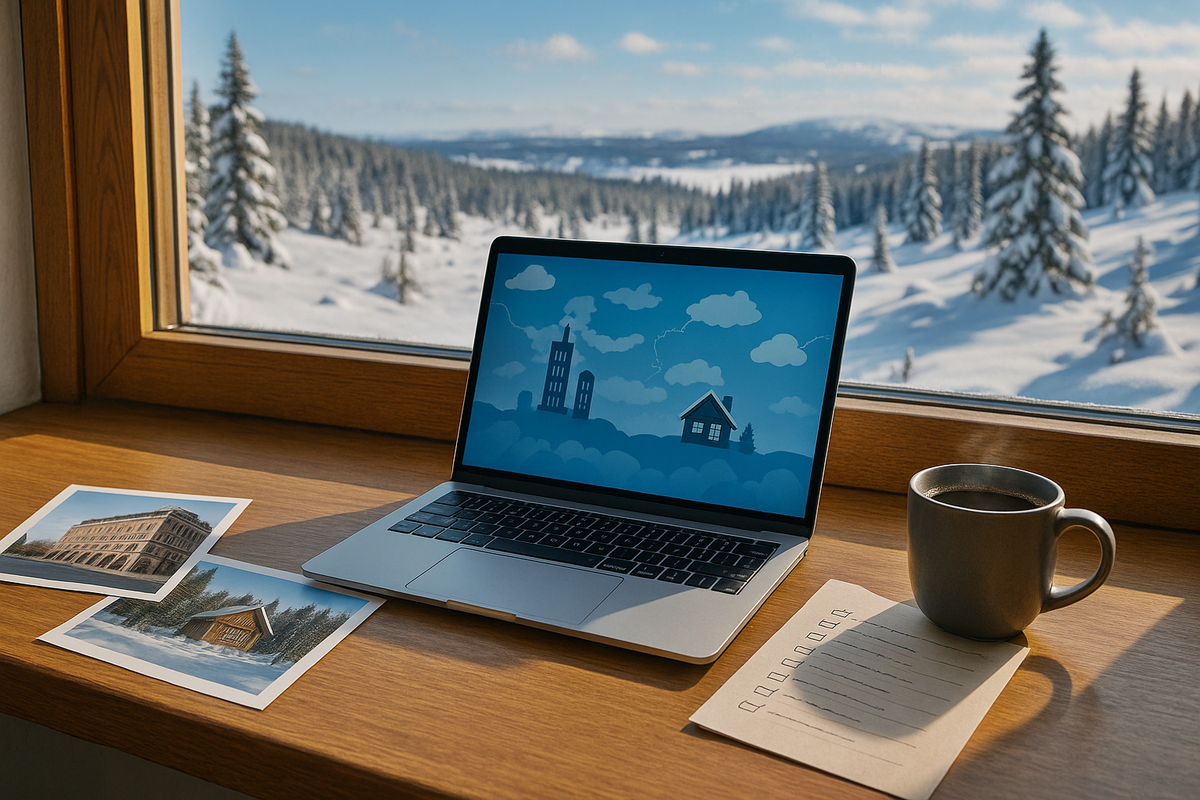
A remote cabin in a genuinely dark zone looks like the dream photo: house, snow, stars and a green arc above the roof. In reality this is a more demanding, “advanced” scenario, especially without a car.
🌌 Pros of a Dark Cabin
- Minimal light pollution. You get exactly that dark sky everyone is chasing.
- The chance to watch aurora literally from your doorstep: no need for long drives if the sky is clear.
- Silence, no buses or crowds, the sense of “we’re really in the North, not near a shopping mall”.
🧊 Cons and Hidden Difficulties
- Transport: without a car you depend on rare transfers, taxis (if any) and timetables.
- Daily life: the nearest supermarket may be 20–40 km away, the nearest restaurant even farther; anything you forgot becomes a problem.
- Psychology: it is genuinely dark and quiet, few people around; this can be stressful for first-timers.
- Weather and roads: a heavy snowfall can literally “lock” you in for a day or more.
🔍 What to Check Before Booking a Cabin
Make sure you really check:
- Distance to the nearest town and shops (in kilometres, not “short drive”).
- Road type: asphalt or gravel, is it ploughed and maintained in winter.
- Street lighting around (sometimes not obvious from photos).
- Mobile coverage and internet.
- Whether there is an option for an organised transfer from the nearest town or airport.
- Presence of sauna, drying room, fireplace – this massively boosts comfort on long dark evenings.
👤 Who a Cabin Format Fits Best
- Those planning 5–7 nights or more, ready to “lose” a couple of nights to cloud cover in exchange for direct aurora from the doorstep.
- Those who have a car and winter-driving experience.
- Those who are comfortable with silence, self-sufficiency and not having a café downstairs.
⚖️ City vs Wilderness: Strategy Comparison, Nights and a Simple Calculator
To make the comparison clear, let’s put key criteria into one table.
| ⚙️ Criterion | 🏙️ City Base | 🏡 Dark Cabin |
|---|---|---|
| 🚍 Transport | Public transport, taxis, tours; rental car optional. | Usually requires a car or pre-arranged transfers. |
| 💡 Light pollution | High in the centre, moderate on the outskirts; normally need to drive to dark zones. | Minimal, often enough to step outside or walk to the lake. |
| 🌠 Chance to see aurora “from the doorstep” | Low, only in very strong events. | Higher, if the sky is clear and the horizon open. |
| 🔁 Location flexibility | Easy to switch areas/tours and drive to different zones by forecast. | Focused on one spot; changing location needs extra trips. |
| 🏨 Comfort & infrastructure | Restaurants, shops, museums, walks; plenty to do in bad weather. | Comfort depends on the cabin; almost no infrastructure outside it. |
| 🧭 Required level of self-reliance | Low–medium: tour operators do most of the heavy lifting. | Medium–high: you must plan, stock up, monitor weather and roads. |
| ⚠️ Risks | Disappointment if you rely only on the “hotel window view”; burnout from over-tight tour schedule. | Isolation in snowstorms, complex logistics, possible discomfort from darkness and silence. |
📆 How Many Nights to Plan & a Simple Calculator
- 1–2 nights give you a chance, but it’s a lottery, especially with changeable clouds.
- 3–4 nights are a minimal sensible horizon to catch at least one clear window.
- 5–7 nights significantly increase your odds, especially if you’re flexible with tours and willing to move for better weather.
As a rough mental model for a good location (Northern Norway, Sweden, Finland) in season, you can assume that in 1 out of 2–3 clear nights you get visible aurora. This is not a formula, just a useful way to think.
Below is a simple “calculator” you can embed on your site: the user enters number of nights and a rough per-night success probability (e.g. 0.4 = 40%); the calculator shows the chance of seeing aurora at least once.
This calculator does not “predict the future”; it simply visualises how adding nights increases your chances, all else being equal.
✅ How to Choose Your Base: Checklist, Forecasts and Managing Expectations
☁️ Box: How to Read Cloud Forecasts
— focus on cloud cover percentage by hour above your area;
— watch the trend, not only “right now” but also 3–6 hours ahead;
— check the cloud height: low solid layers are worse than broken high clouds;
— compare several sources and cross-check them with the real sky in the evening.
🌃 Box: How to Estimate Light Pollution
— look at a map to see the distance to the nearest city and main road;
— the fewer villages and roads within a 10–20 km radius, the better;
— in photos and descriptions look for “street lights”, “neighbour houses” – that often means extra light;
— if possible, cross-check the location on a light pollution map (no need to mention a specific service).
💭 Box: What to Do If Aurora Was Forecast but You Didn’t See It
— don’t treat it as a “mistake” — weather and geomagnetic activity always have a random factor;
— use the experience: you now understand logistics, clothing and your personal comfort limits better;
— next time plan more nights and either a hybrid strategy (city + dark base) or more tours;
— try to fill the trip with other activities so it’s not reduced to a single “event”.
📋 Checklist: How to Decide “City vs Cabin”
- How many nights do you have?
- 1–3 nights → a city + tours setup is almost always more rational.
- 4–7 nights → you can consider a hybrid or a dark cabin if you have a car.
- Do you have winter night-driving experience?
- No → don’t build a plan that fully relies on a car.
- Yes → a cabin gives more autonomy, but you still need Plan B and C.
- How important are comfort and city life to you?
- If you love restaurants, walks and museums → city base plus maybe 1–2 nights in a darker area.
- If you’re happy with total quiet and self-catering → a cabin becomes more logical.
- Are you okay with real darkness and silence?
- If the idea of a black night with no street lamps makes you anxious, a pure “middle of nowhere” start is not ideal.
- Budget for tours and accommodation.
- City + tours: more predictable costs, easy to combine different formats.
- Cabin: can be cost-effective per night for a group, but increases spending on transport and supplies.
- Are you ready to change plans based on forecasts?
- In the city it’s easier to book tours by forecast and swap activities between days.
- In a cabin you’re tied to one location and one horizon.
❓FAQ
💬 Theoretically yes, but only during very strong events, so it shouldn’t be your main strategy.
💬 A reasonable minimum is 3–4 nights, and the comfortable range for a first-timer is 4–6 nights.
💬 Not always, but without planned transfers and supplies it often turns into stress rather than a relaxing trip.
💬 For most beginners a city with several tours wins, because tours actively drive towards cloud gaps.
💬 Yes, if you have 5–7 nights: a couple of nights in a cabin plus a city base with tours gives you both flexibility and dark sky at your doorstep.

0 comments
Log in to leave a comment