


🎄December in Scandinavian capitals: fairs, short days, and "dead" holidays
December in Scandinavia means fairy lights and mulled wine, short days and the feeling that “the city is about to be switched off”. Many travellers worry that in Copenhagen, Oslo, Stockholm and Helsinki “everything will be closed” on key dates — and that instead of a Christmas fairytale they’ll get empty streets and locked doors.
In reality, it’s more nuanced: yes, there are genuinely “dead” days, but for most of December the cities are open, running Christmas markets and welcoming visitors — just in a winter rhythm. The question is not “where to go”, but when in the day and on which dates it actually makes sense to plan activities.
This guide is your reference for December in the four Nordic capitals. You will get an honest breakdown of daylight and weather, a calendar of “lively” and “half-dead” dates, a comparison of atmosphere and prices, ready-made 2–3 day scenarios and practical advice on clothing and surviving the markets. The main question we answer is: “Is it worth going in December at all?” — and the honest answer is: it depends whether you’re coming for lights, museums or heavy shopping.
🌤️ Daylight and Weather: How Many “Living” Hours You Really Have
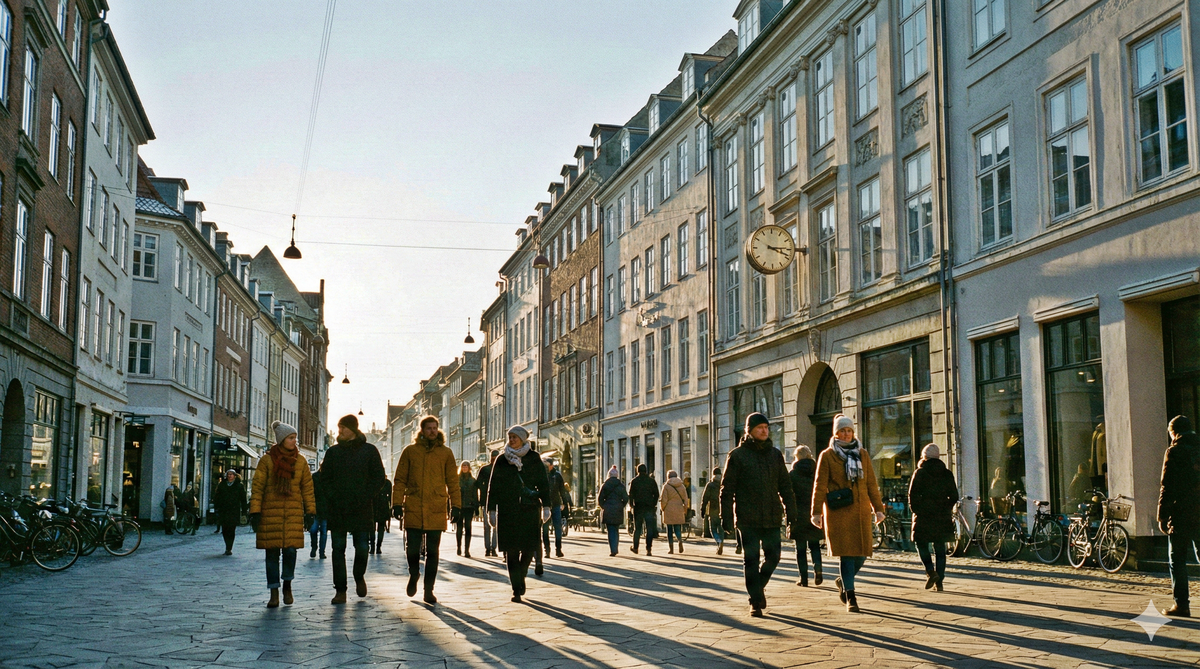
How much light is there, really?
The standard myth goes: “In December in Scandinavia it’s almost always night: two hours of grey daylight and 22 hours of darkness.” In practice, the capitals are much milder: it’s a short winter day, but not a catastrophic one.
Reference points for mid-December (roughly 15–20th):
- Stockholm – about 6–6.5 hours of daylight, sunset around 14:45–14:50.
- Oslo – around 6 hours of daylight, sunset roughly 15:10–15:15.
- Helsinki – similar to Oslo: about 6 hours, with sunset near 15:10–15:15.
- Copenhagen – the “best case”: around 7 hours of daylight, sunset around 15:30–15:40.
It’s important to remember that beyond the official daylight hours there are twilight periods before and after, when the city is still/again alive with lights, shop windows and a sky that isn’t pitch black yet. Visually, the capitals feel lively for longer than the raw numbers suggest.
Weather: not the Arctic, but damp and windy
A typical December in these cities is not guaranteed knee-deep snow, but temperatures between about –5 and +5 °C, increasingly often a mild pattern around 0…+6 °C. Snow may appear, but you shouldn’t treat it as a guaranteed bonus: it falls, melts, turns into slush and comes back again.
Key features:
- Wind and humidity make it feel colder even at +2…+4 °C.
- Proper frost (–5…–10 °C) happens, but usually in short bursts.
- In Helsinki and Oslo the chance of stable snow is higher than in Copenhagen and Stockholm, but again, there are no guarantees.
Structuring your day around the light
A short day in December is not a reason to cancel your trip; it’s a reason to structure your itinerary more tightly:
- Morning and midday (roughly from 9:30 to 14:30) – anything that relies on views, walking, panoramas and good photos outdoors.
- After 15:00 – focus on indoor activities: museums, cafés, shopping, saunas, restaurants, and Christmas lights, which actually look better in the dark.
To make planning easier, you can treat December roughly like this:
| 🏙️ City | 🌅 Sunrise / sunset (mid-December) | ☀️ Daylight hours | 🌡️ Typical temperature |
|---|---|---|---|
| 🏙️ Copenhagen | ~8:30 / 15:30–15:40 | ~7 hours | from –2 to +6 °C |
| 🏙️ Oslo | ~9:00 / 15:10–15:15 | ~6 hours | from –5 to +2 °C |
| 🏙️ Stockholm | ~8:45 / 14:45–14:50 | ~6–6.5 hours | from –4 to +3 °C |
| 🏙️ Helsinki | ~9:15 / 15:10–15:15 | ~6 hours | from –6 to +2 °C |
Bottom line: “It’s almost always night” is a myth. You have 6–7 hours of daylight, plus several hours of “comfortable” twilight with lights – as long as you structure your day sensibly.
📅 “Dead Days” and Living Markets: How 24–26 and 31–1 Actually Work
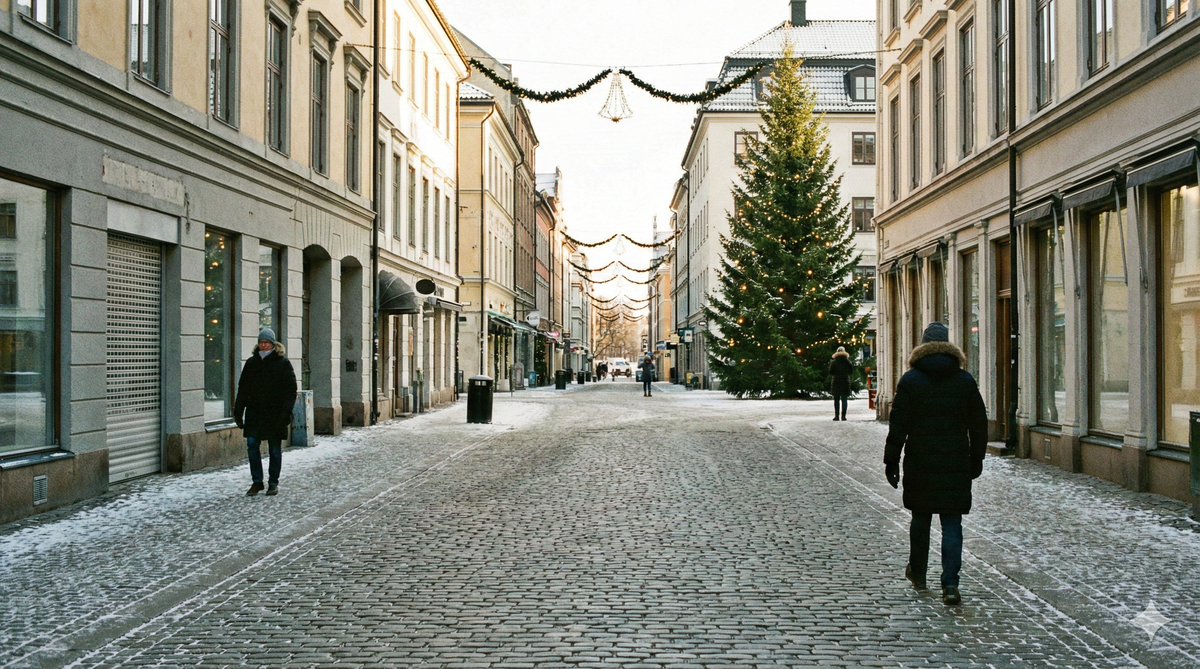
The basic December rhythm
Up until roughly 20–23 December, the capitals live in a “work month + holiday” mode:
- Christmas markets are already open.
- Shops often have extended opening hours, including Sundays.
- The mood is peak lights and buzz, but without the extreme crowds (especially early in the month).
The main risk of “the city is dead” is concentrated around 24–26 December and 31–1 January.
What actually happens on key dates
Rough, aggregated picture across Copenhagen, Oslo, Stockholm and Helsinki:
| 📅 Date | 🛒 Shops | ☕ Cafés / restaurants | 🎡 Museums / attractions | 🚋 Public transport |
|---|---|---|---|---|
| 📅 24 December | Open in the morning, closing around 14:00–16:00 | Some are open during the day, in the evening mostly closed or reservation only | Many are closed, some have shorter opening hours | Running, but on a reduced/pre-holiday schedule |
| 📅 25 December | Mostly closed | A few hotels/tourist places are open | Mostly closed | Holiday timetable, longer intervals |
| 📅 26 December | Some shopping centres and stores reopen | More places are open, but still on a “holiday” schedule | Some museums reopen, some are still closed | Holiday/shortened timetable |
| 📅 31 December | Open until lunchtime / mid-afternoon | In the evening — restaurants with New Year’s set menus | Some are closed, others open only until 14:00–15:00 | Holiday schedule, early shutdowns possible |
| 📅 1 January | Mostly closed or with a late start | Some cafés open closer to midday | Most are closed or have very short opening hours | Holiday timetable |
How to use this when planning
- 24 December – workable if you pre-booked a restaurant or hotel dinner and are ready for “active morning, quiet evening”.
- 25 December – a genuinely very quiet day; best for city walks, viewpoints, parks, waterfronts, plus a short list of cafés and hotel restaurants you’ve checked in advance.
- 26 December – life gradually restarts: you can plan for shopping and some museums.
- 31 December – daytime is short, but the evening is compensated by fireworks and squares.
- 1 January – the second “semi-dead” day; a good plan is a late breakfast, walk, sauna (especially in Helsinki/Oslo) and one pre-selected open museum or market.
Practical hack: if you can, avoid scheduling long transfers or flights on 24, 25, 31 and 1. These dates are tightly bound to reduced timetables, tricky connections and a higher risk of delays and disruptions.
🎪 Atmosphere and Prices: How December Differs Across the Four Capitals
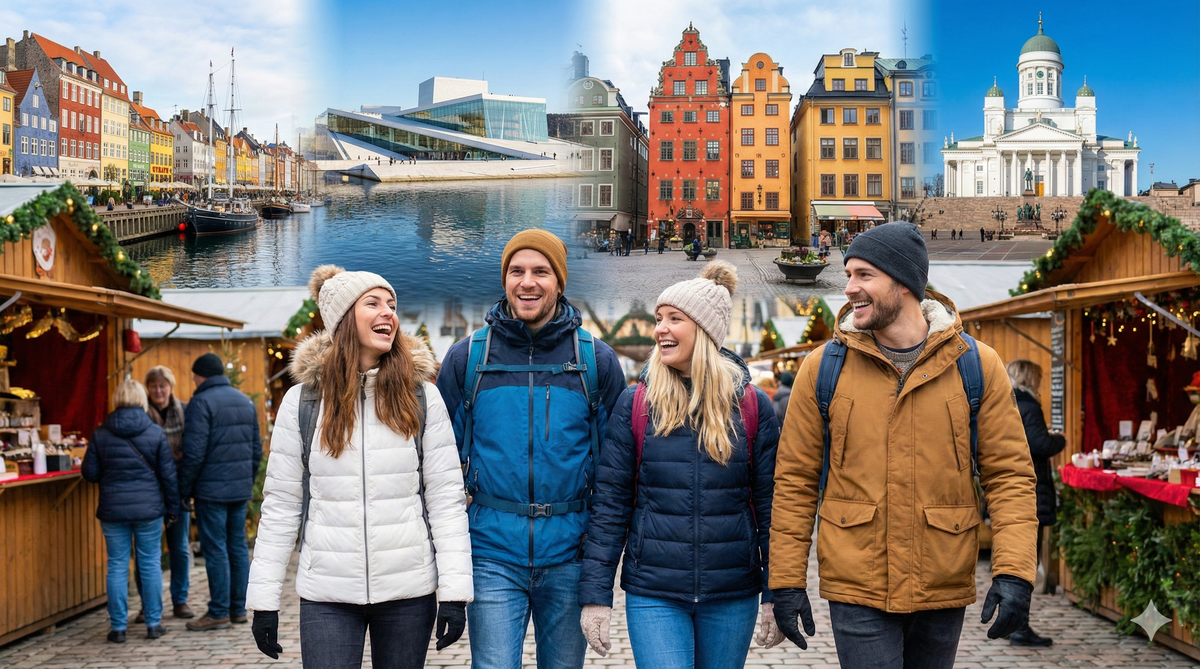
Copenhagen: Tivoli, canals and a dense Christmas vibe
In December, Copenhagen delivers a highly concentrated package: Tivoli with lights and rides, markets around Nyhavn and in the city centre, decorated streets and shop windows. It’s a city where you can build your entire holiday experience within a walkable radius – but you’ll pay for that convenience: food and accommodation are among the most expensive in the region.
Best for travellers who want:
- maximum Christmas postcard effect in a compact area;
- a combination of markets, gastronomy and design;
- a relatively mild climate (+0…+5 °C, but windy).
Stockholm: Fairytale Gamla Stan and a calmer rhythm
December in Stockholm is all about Gamla Stan with its courtyards and markets, winter light along the waterfront, museums and galleries. The visuals are very fairytale-like, but the overall rhythm of the city feels calmer than Copenhagen: more space, slightly fewer crowds and less noise.
Best for travellers who want:
- a “postcard” old town, but not wall-to-wall attractions;
- a balance of walking, museums and cafés;
- a more classic “northern city on the water”.
Oslo: Fjord, compact centre and a focus on nature
Oslo in December leans into a compact centre with markets (around the skating rink and main street), the waterfront, fjord views and winter activities. There are fewer traditional markets than in Copenhagen or Stockholm, but a stronger sense that nature is just around the corner: forest, hills and ski trails are only a short train ride away.
Best for travellers who want:
- a mix of city + quick access to nature;
- less market noise, more space;
- the option of winter fjord views, skiing and hillside walks.
Helsinki: Markets, sauna and a quiet “winter capital”
Helsinki has different focal points: one or two flagship Christmas markets (for example, by the cathedral), bright central lights and a very strong sauna culture. The atmosphere is more introverted: less theatrical show, more “own pace” and local routine.
Best for travellers who want:
- to mix a central market + sauna + Baltic waterfront walks;
- a calm December capital without a theme-park feel;
- a slightly harsher, “Baltic” North.
Prices and visitor load in December
You can summarise the capitals in a simple matrix:
| 🏙️ City | 🎭 Atmosphere focus | 💶 Price level* | 🎯 Who December is especially good for |
|---|---|---|---|
| 📍 Copenhagen | Tivoli, markets, canals, design | 💰💰💰 (very high) | Couples, lovers of markets and gastronomy |
| 📍 Stockholm | Old town, museums, markets | 💰💰 (high) | Those who want a “fairy tale” + calm atmosphere |
| 📍 Oslo | Fjord, markets, nature, activities | 💰💰 (high) | Active travellers, nature lovers |
| 📍 Helsinki | Markets, sauna, quiet centre | 💰💰 (medium–high) | Introverts, sauna and design fans |
*Price level is relative, taking into account accommodation, food and basic activities.
By date:
- The most expensive periods are 20–23 December and New Year week (hotels, flights, popular restaurants).
- Relatively quieter and cheaper – early December and the stretch between Christmas and New Year, aside from a few peak days.
🗺️ 2–3 Day Scenarios: Getting the Most Out of a Short Day

The principle: plan not only “where” but also “when in the day”
With 6–7 hours of light and “dead holidays”, it’s not enough to pick a city; you need to understand your trip format: are you here for museums, lights, saunas, shopping or family-friendly attractions? Below are universal 2–3 day templates that can be adapted to any of the four capitals.
Template “City Indoors” (museums + markets + views)
Best for: solo travellers and couples who want a mix of museums, lights and urban atmosphere.
Template “Sauna / SPA + Lights”
Best for: those heading to Helsinki or Oslo, but easily transferable to other cities (SPA centres, thermal baths, pools).
Template “Family” (with kids)
Best for: families aiming for parks, zoos, interactive museums, with early dinners and calmer evenings.
A rough 2–3 day December visit might look like this:
| 🗓️ Day | 🌅 Morning (daylight peak) | 🌞 Daytime (transition block) | 🌙 Evening (dark, lights) |
|---|---|---|---|
| 📅 Day 1 | “City indoors”: a major museum (national gallery / design / history) in Copenhagen or Stockholm | Walk through the city centre and Christmas market, coffee/mulled wine | Viewpoint: Ferris wheel, tower, waterfront with lights |
| 📅 Day 2 | “Sauna / SPA”: urban complex in Helsinki or Oslo, swimming + relaxation | Quiet lunch, short walk around the neighbourhood / along the water | Lights and Christmas installations, dinner in a cosy restaurant |
| 📅 Day 3 | “Family day”: amusement park (Tivoli, winter park) or interactive museum | Indoor activity: science centre, aquarium, zoo (partly) | Early dinner, stroll through the market and along the waterfront, packing / departure |
Principles that work in any city:
- The most energy-demanding activities (museums, longer walks, viewpoints) go in the morning and until roughly 14:00–15:00.
- Markets, lights, sauna, restaurants and cafés belong after sunset.
- If you hit 25 December or 1 January, the scenario leans towards long walks, nature and a very short list of pre-checked open venues.
🧥 Clothing, Surviving the Markets and a Mini-FAQ
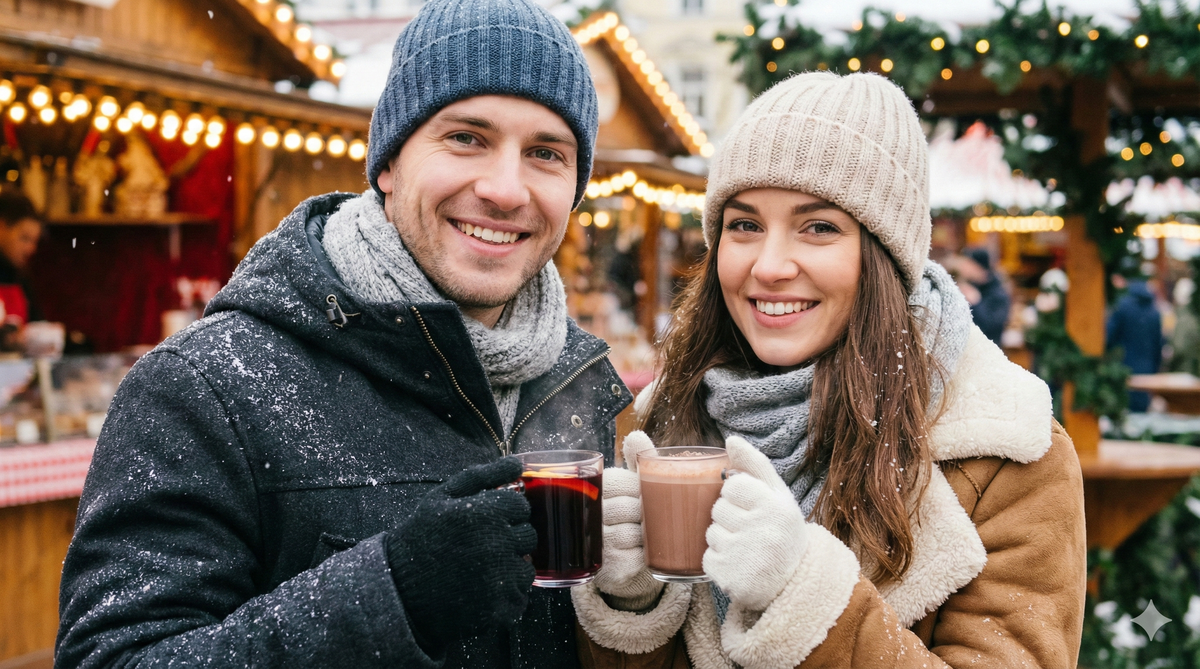
How to dress so you don’t freeze and don’t end up hating the markets
Your main enemy in December is not so much low temperatures as the combo of wind, humidity and standing still. The basic clothing formula is:
- Base layer (bottom): thermal underwear + regular trousers / lined jeans.
- Base layer (top): thermal top / long sleeve + fleece / wool mid-layer + wind- and waterproof shell.
- Footwear: warm, ideally waterproof boots, plus spare socks in your daypack.
- Accessories: hat, gloves and scarf / buff are essential even at +3…+5 °C because of the wind and high humidity.
Christmas market survival hacks
- Don’t stand in one spot for an hour: alternate food, rides, walking and visits to warm spaces.
- Plan “warm anchors” in advance: a café, museum, church or mall close to the market where you can escape the wind for 30–40 minutes.
- Keep your phone and power bank close to your body: batteries drain much faster in the cold.
- Hot drinks don’t have to mean alcohol: you’ll always find cocoa, tea and non-alcoholic options that genuinely help you warm up.
❓FAQ
✅ Yes, if you’re coming for lights, atmosphere and indoor cosiness rather than long daylight and beach-style holidays.
✅ The quietest days are 25 December and 1 January, with a semi-shutdown mode on 24 and 31 December.
✅ For the most “postcard-like” Christmas, go to Copenhagen or Stockholm; for saunas and calm, choose Helsinki; for city + nature, pick Oslo.
✅ Put anything that needs views and light between about 09:30 and 14:30, and keep markets, cafés, saunas and lights for after sunset.
✅ Layered clothing, warm waterproof footwear, hat/gloves/scarf and a bit of patience with wind and dampness – then December in Scandinavia will more than reward you.

0 comments
Log in to leave a comment