


🌉 Copenhagen–Malmö: Train or Car? Budget Breakdown for 1–4 People
The Copenhagen–Malmö link is one of the most convenient cross-border routes in Scandinavia. 🚆 Trains over the Øresund Bridge run roughly every 20 minutes at peak times, and the journey between the two city centres takes about 35–40 minutes.
Driving across the Øresund Bridge gives you flexibility: it’s convenient for outlet runs, big shopping trips, sports events and travelling with luggage, without being tied to a timetable. But the cost of the bridge, fuel and parking quickly changes the economics, especially if you’re travelling alone or as a couple.
There is never a single, universal answer to “cheaper or more expensive”: everything depends on whether you’re travelling solo or with three friends, what fare you got on the train, whether you have ØresundGO and how often you make the trip. In this article you’ll find clear scenarios and a simple calculator so you can immediately see when the train wins on budget and time, and when the car starts to compete on price and clearly wins on convenience.
🚆 Copenhagen–Malmö Route: Travel Options and Basic Choice Logic

Geography and travel time
Copenhagen and Malmö are connected by the Øresund Bridge: the railway and motorway run in the same corridor.
- Train (Öresundståg, SJ Regional, DSB/Skånetrafiken): travel time between Copenhagen Central (København H) and Malmö Central is about 35–40 minutes; trains run roughly every 20 minutes during the day on weekdays, slightly less frequently in the evenings and at weekends.
- Car: the drive from central Copenhagen to central Malmö via the Øresund Bridge takes around 45–60 minutes, depending on traffic and access roads.
Main options for the route
- Train. Öresundståg/DSB/Skånetrafiken using the bridge corridor; ideal if you’re travelling light, without large shopping bags or sports gear.
- Car (own or rental). Via Øresund Bridge along the E20; perfect for shopping trips, regular trainings/competitions, journeys with luggage and kids.
- Bus. FlixBus and other operators, travel time about an hour; tickets are usually cheaper than the train, but schedules are less flexible and comfort is lower.
Basic choice logic
- 1–2 people, no bulky items → the train is usually the best choice: cheaper, more predictable, no parking worries.
- 3–4 people, shopping, bikes, sports equipment → the car starts to compete, especially if you have ØresundGO and plan parking smartly.
- Regular trips (commuting, trainings, work) → you need to compare season tickets/passes for the train and long-term discounts for the bridge (ØresundGO/BroPas); in that horizon the car can become attractive over months or a year.
🎫 H2-2. Copenhagen–Malmö by Train: Fares, Tickets and Scenarios for 1–4 People
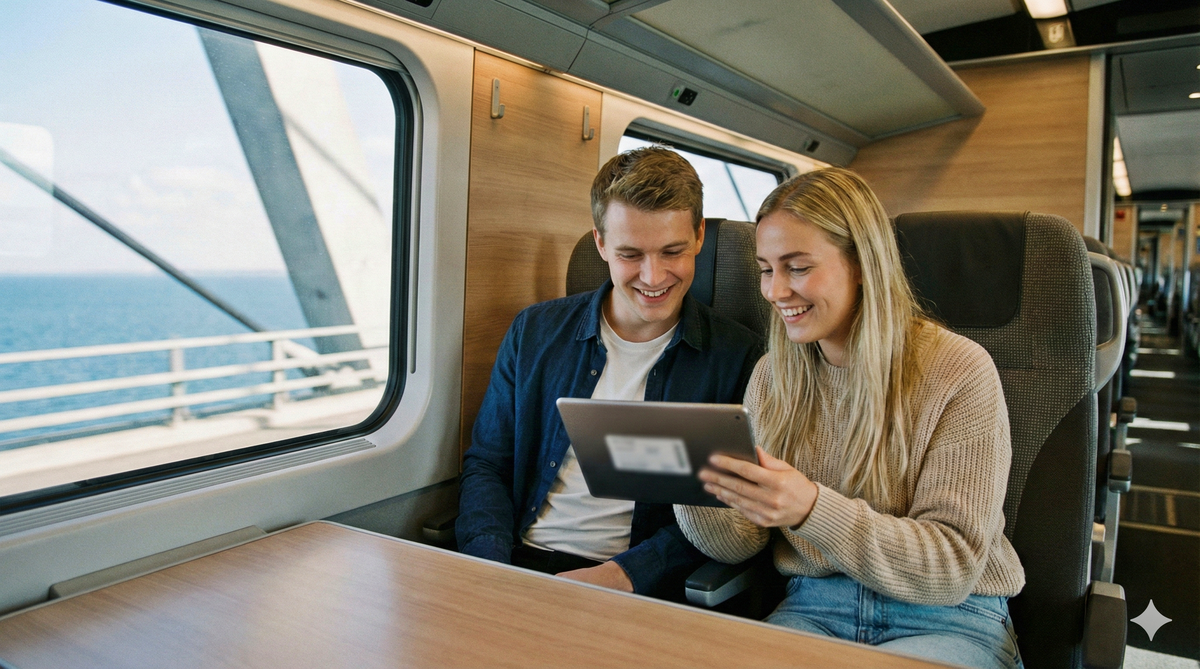
Frequency and base price
Trains between Copenhagen and Malmö:
- run every ~20 minutes during the daytime (a bit less often in evenings and at weekends);
- travel time is 34–40 minutes.
Prices:
- according to recent guides and aggregators, a standard one-way ticket in 2025 typically starts around 95–140 SEK, which corresponds to roughly 90–100 DKK, depending on origin, destination and purchase timing;
- if you buy closer to departure and at peak times, the price can climb to ~150–170 SEK (~110–120 DKK) one way.
As a practical rule of thumb you can use:
~100 DKK one way per person for a standard ticket.
Ticket types and discounts
- Standard single ticket (via DSB/Skånetrafiken): the obvious choice for a simple one-day round trip.
- Øresund Ticket / regional tickets: can be more attractive if you combine the trip with additional travel in Zealand and Skåne.
- Rejsekort / Skånetrafiken regional cards: convenient if you live in the region and travel regularly.
- Family and child/youth fares: children and young people often get discounts, making the train particularly attractive for families.
Train scenarios for 1–4 people (day trip)
Approximate return cost based on 100 DKK per leg:
| 👥 Number of people | 🚆 Approx. train cost (RT) |
|---|---|
| 👤 1 | ~200 DKK |
| 👥 2 | ~400 DKK |
| 👥 3 | ~600 DKK |
| 👨👩👧👦 4 | ~800 DKK |
With good timing (discounts, early purchase) the numbers can be slightly lower; with last-minute peak-time tickets they’ll be closer to the top of the range.
💡 For a one-person same-day round trip, the train almost always beats the car on price and also removes all hassle with parking and crossing formalities.
🚗 H2-3. Car via Øresund: Bridge, Fuel, Parking and Rental
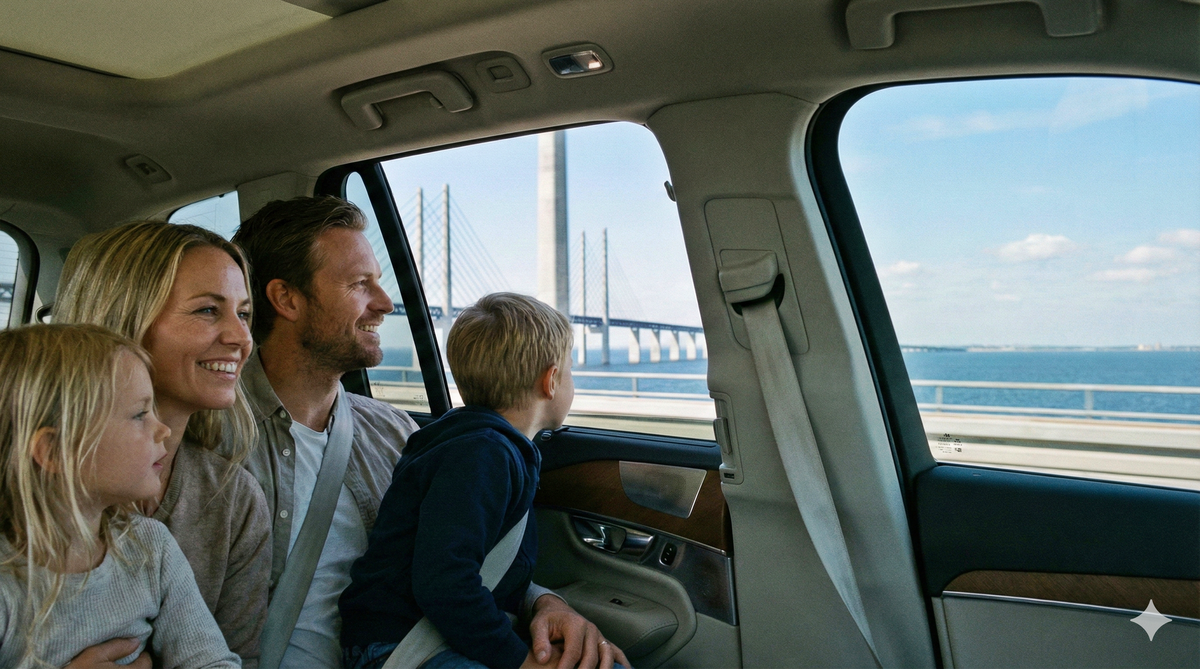
Øresund Bridge cost for a passenger car
The official Øresund Bridge price list for private customers up to 31 December 2025 (car under 6 m):
- ØresundGO: 178 DKK per crossing;
- online ticket: 414 DKK;
- standard pay-on-passage price (no contract): 460 DKK.
ØresundGO requires an annual fee (several hundred kroner), so it only pays off with regular trips.
For a simple one-day round trip without discounts:
Bridge RT = 460 × 2 ≈ 920 DKK.
Fuel: what the trip consumes
The distance between Copenhagen and Malmö is around 40–45 km using the bridge and access roads.
Let’s assume:
- total distance RT (there and back) ≈ 100 km (including city access);
- fuel consumption: 6.5 l/100 km;
- petrol price in Denmark: ~14 DKK/l in 2025.
Fuel for one day trip:
100 km × 6.5 l/100 km × 14 DKK ≈ 91 DKK → we round to ~100 DKK.
Parking: Copenhagen + Malmö
Copenhagen
Since 2025, Copenhagen has higher parking tariffs in its zones:
- red and green zones — ~44 DKK/hour;
- blue — ~26 DKK/hour;
- yellow — ~16 DKK/hour;
- evenings (18:00–23:00) — ~17 DKK/hour, nights — about 6 DKK/hour.
Malmö
Based on recent guides, central Malmö parking typically costs ~25–30 SEK/hour, and some streets and car parks are around 20 SEK/hour — roughly 15–25 DKK/hour.
If you plan 3 hours of daytime parking in Copenhagen and 3 hours in Malmö, you get approximately:
- Copenhagen: 3 × 44 ≈ 132 DKK;
- Malmö: 3 × ~20 SEK ≈ 60 SEK ≈ 40–50 DKK;
Total parking for the day: ~170–200 DKK.
Rental car: when it’s clearly not worth it
If you rent a car solely for the Copenhagen–Malmö run, then on top of bridge, fuel and parking you have:
- the daily rental rate (often 450–800 DKK/day or more);
- insurance / excess reduction;
- a blocked deposit on your card.
In this configuration, a rental car is almost always more expensive than the train, especially for 1–2 people. The car starts to make sense only if it’s already rented for a larger itinerary (a week in Denmark/Skåne, a sports tour, broader road trip, etc.).
⚖️ H2-4. Train vs Car: Calculator for 1–4 People and Different Scenarios
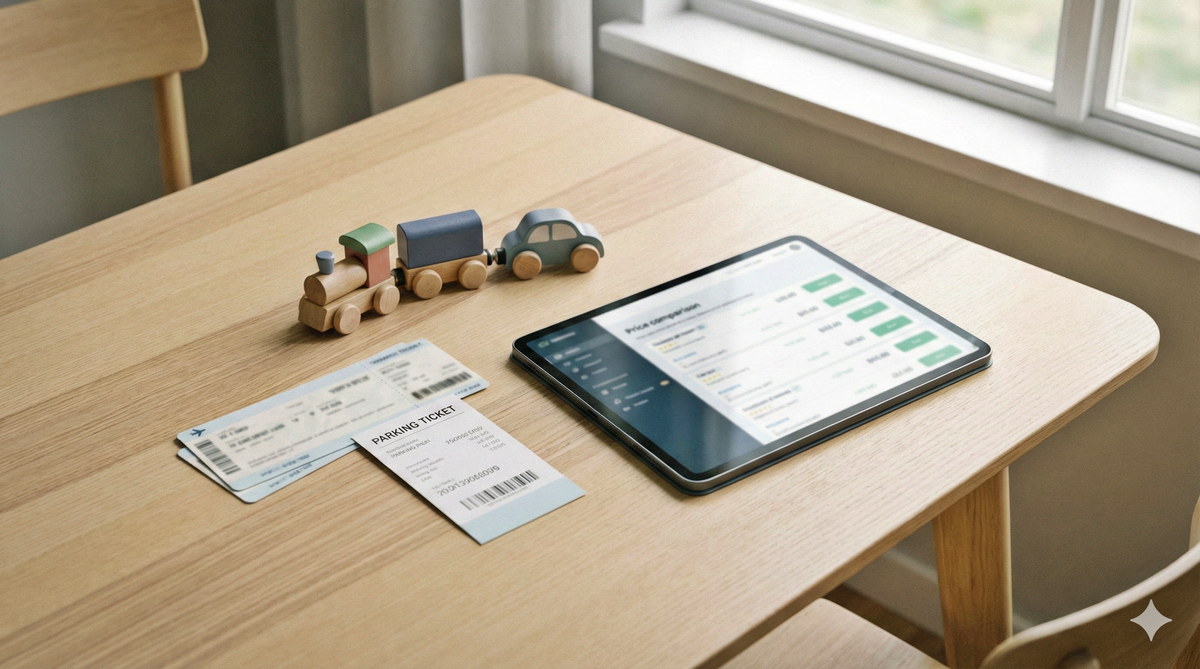
Below are simplified day trip scenarios (round trip in one day). All numbers are approximate, for budgeting purposes; always check live prices with the official train and bridge operators.
Scenario A: 1 person, day trip
Train
- 2 × 100 DKK = ~200 DKK for the day.
Car (no discounts on the bridge)
- Øresund Bridge RT: ~920 DKK;
- fuel: ~100 DKK;
- parking in both cities: ~170–200 DKK;
Total for car: ~1,190–1,220 DKK.
The difference is obvious: the train is roughly six times cheaper and much simpler in terms of logistics.
Scenario B: 2 people, day trip
Train
- 2 people × 2 tickets × 100 DKK = ~400 DKK (without factoring in potential family/group discounts).
Car (no discounts)
- same car bill: ~1,190–1,220 DKK;
- per person: ~600+ DKK.
Even for two people, the train clearly remains cheaper.
Scenario C: 3–4 people, day trip without discounts
Train
- 3 people: ~600 DKK;
- 4 people: ~800 DKK (or slightly less if you catch good fares).
Car (no discounts)
- same total: ~1,190–1,220 DKK;
- per person: 3 people → ~400 DKK; 4 people → ~300 DKK.
For 4 people, the car becomes comparable in price per person to the train, especially if you optimize parking (cheaper zones, shopping centres with discounted parking, etc.).
Scenario D: 3–4 people + ØresundGO and regular trips
If you live on one side of the bridge and regularly travel to the other (sports, work, shopping):
- ØresundGO cuts the fare to 178 DKK per crossing, i.e. 356 DKK per round trip, plus the annual fee;
- add fuel (~100 DKK) and parking (~170–200 DKK):
A ballpark figure per day: ~630–660 DKK (excluding the annual ØresundGO fee, which is spread over multiple trips).
If you make 8–10 trips per year with 3–4 passengers, the per-person cost by car starts to look noticeably lower than the train, while still being more convenient for luggage and timing.
Block conclusions
- For 1 person, the train almost always wins, both in price and simplicity.
- For 2 people, the train is still cheaper, especially without ØresundGO.
- For 3–4 people, without discounts car and train costs converge, and with ØresundGO, smart parking and regular trips the car can become cheaper per person and significantly more comfortable.
🧭 H2-5. Seasonality, Hacks and Practical Tips
Seasonality and crowding
- In summer, on weekends and holidays, trains can be much more crowded, but the base fare range stays similar if you buy in advance.
- Car rentals and hotels get more expensive in high season, strengthening the case for the train for solo travellers and couples.
Train hacks 🚆
- Buy tickets online in advance and watch for group/family deals and promotions.
- If you live in the region, consider Rejsekort or Skånetrafiken regional cards – they simplify payment not only to Malmö but for travel on both sides of Øresund.
Car hacks 🚗
- If you plan recurring trips, consider ØresundGO/BroPas: just a handful of round trips per year starts to offset the annual fee.
- Combine tasks: shopping + events + training in one visit, so you can spread the cost of the bridge and parking over several purposes.
- Use parking apps (EasyPark, APCOA and others) in both countries to find cheaper zones and keep tight control of parking times.
Practical border reminders
- Between Denmark and Sweden, spot ID checks are sometimes carried out on both trains and road traffic: always carry your passport or national ID.
- Before travelling, double-check current prices and conditions on the official Øresund Bridge, DSB and Skånetrafiken websites: this article uses 2025 figures as guidance, but fares are indexed over time.
💡 The key is to calculate your real scenario first (number of people, trip frequency, need for luggage and shopping), and only then decide what should be your default — train or car.
❓FAQ
✅ The train is usually faster and more predictable in travel time, while the car offers more flexibility for route and luggage.
✅ As a rule of thumb, plan for about 200 DKK for a same-day round trip at a standard fare without promotions.
✅ Without discounts, plan roughly 1,200 DKK for bridge tolls, fuel and parking for a single day.
✅ At 3–4 people without discounts the costs begin to converge, and with ØresundGO and regular trips the car can become cheaper per person.
✅ You should calculate bridge, fuel and parking in advance and compare the per-person cost with train fares for your group size and trip frequency.

0 comments
Log in to leave a comment