


🚙 Car Rental in Denmark: Real Costs, Hidden Charges and Fuel
When you search for a rental car in Denmark, the price you see in comparison sites looks pretty harmless – “from XX € per day” and glossy photos of new cars. 🚗 For active travelers, sports teams and expats, a car seems like the logical choice: training sessions, races, trips around the country, total route freedom. But the final bill for 7–10 days including insurance, deposits, toll bridges, fuel and parking often turns out to be 1.5–2 times higher than expected.
In this guide we’ll unpack all the key cost items and build an approximate weekly rental calculator for Denmark, so you see the real number, not just the marketing “from”.
🚙 Base Rental Cost: Rates, Car Classes and Deposits
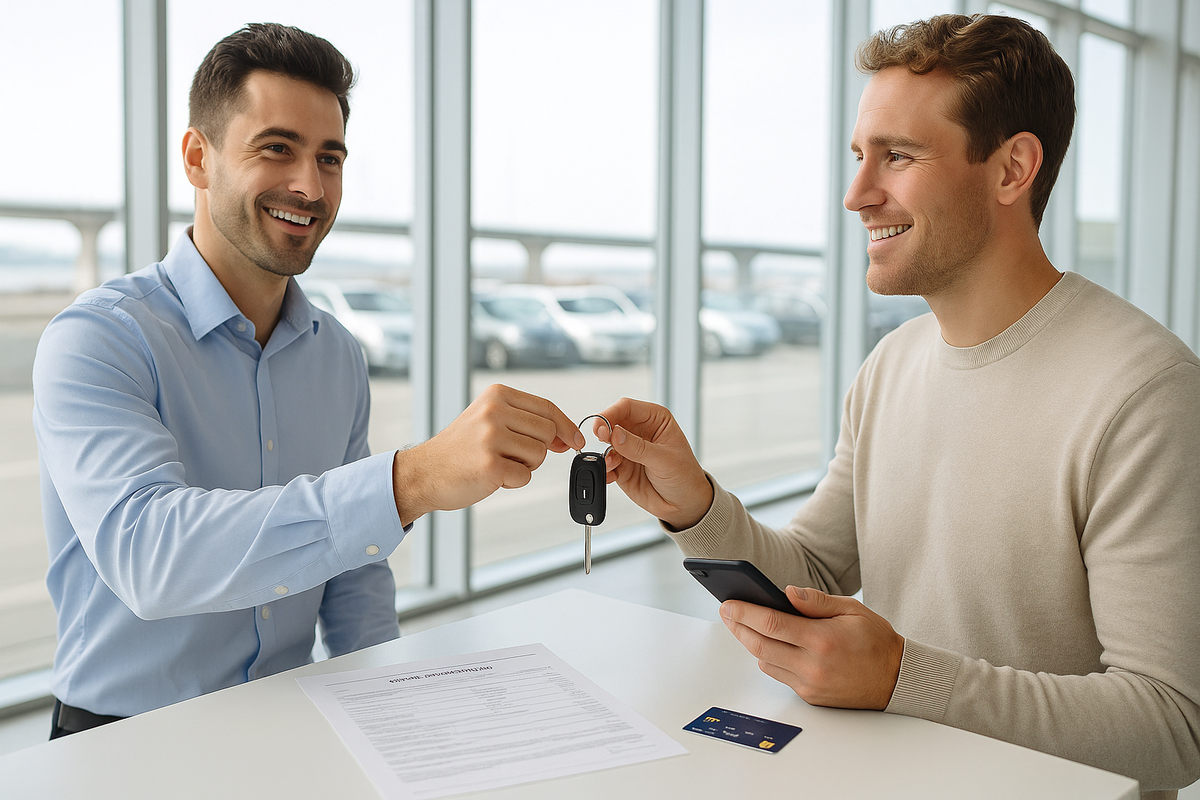
Market snapshot: from “compact” to minivan
In Denmark, you’ll find all the major international brands (Avis, Hertz, Europcar, Sixt, Budget, Enterprise, etc.) plus a number of local companies. Daily rates vary a lot by season, city and car class, but based on aggregators and metasearch tools you can outline some rough benchmarks: for a 7–10 day rental, the average daily rate for a small or mid-size class is often in the range of ~450–800 DKK/day, while premium cars and minivans easily go beyond 1,000 DKK/day.
👉 Practical benchmark for budget planning (7–10 days, booked in advance):
| 🚗 Car class | 📊 Approx. range for 7–10 days rental* |
|---|---|
| 🚘 Small / compact (A/B) | ~450–650 DKK/day |
| 🚘 Medium (C, compact estate) | ~550–800 DKK/day |
| 🚘 Estate / minivan | ~800–1 200 DKK/day |
* Not including zero-excess insurance and paid extras.
What usually is included in the base rate
The “base” bundle varies by company, but typically includes:
- Limited or unlimited mileage (sometimes there is a daily limit – always check the conditions);
- Third-party liability – mandatory by law;
- Basic CDW/LDW with an excess that still remains on the customer;
- Taxes and mandatory fees (including airport surcharge if you pick up at the airport).
🎗️ Important: the very cheapest price in search results is often a “bare-bones” rate with a mileage limit and a high excess. Everything that makes your trip stress-free (lower excess, second driver, child seats) is added on top at the counter or during online booking.
Deposit and available limit on your card
A separate story is the deposit (pre-authorisation):
- A typical deposit in Denmark for a standard car is around 8,000–12,000+ DKK, sometimes more for expensive classes and high-excess packages;
- The amount is blocked on a credit card (debit cards are often not accepted or only under restrictions);
- If your limit isn’t sufficient, the rental desk may: refuse to hand over the car; insist you buy a more expensive insurance package to reduce the deposit.
💡 When planning a rental in Denmark, you need to think not just about the daily rate, but also about whether your card can handle a block of 8–12k DKK + your ongoing travel expenses (hotel, food, race fees, etc.).
🛡️ Insurance and Hidden Charges: CDW, Excess, Extras
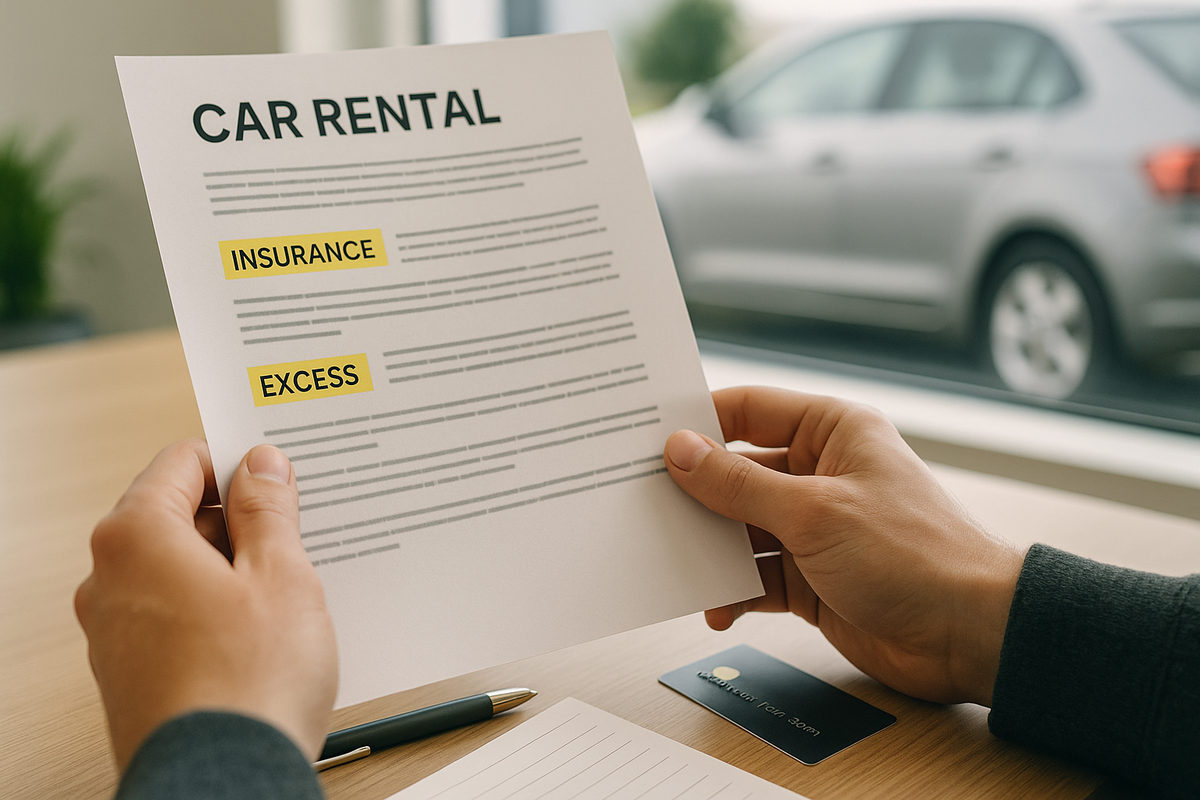
Basic insurance: what you get “by default”
As in most of Europe, Danish rentals normally include:
- Third-party liability (TPL) – required by law;
- CDW/LDW (collision / loss damage waiver) with an excess that remains on you in case of damage or theft.
The excess can easily be 8,000–12,000 DKK or more, especially for crossovers, estates and minivans. For a car that’s actively driving between race venues, training sites and gravel parking at sports facilities, that’s a significant risk.
Reducing or eliminating the excess: what it costs
Almost all rental companies offer optional insurance that reduces or eliminates your excess. In real bookings, the surcharge often looks like this:
- +80–150 DKK/day for a package with a significantly reduced excess;
- +120–200 DKK/day for a “zero excess” package (Super CDW, Complete Protection, etc.).
Over 7–10 days this becomes +800–2,000+ DKK on top of your budget, but with intensive use (frequent trips, unfamiliar roads, sports equipment in the trunk) it can be a reasonable hedge against a “minus” of tens of thousands of kroner.
Extra charges people often forget about
A typical list of “small items” that turn into big money:
- 👥 Second driver – fixed daily fee or a flat fee for the whole rental;
- 👶 Child seats – usually a paid option;
- 🚴 Bike / ski racks – especially relevant for sports teams;
- 🧭 GPS – often cheaper to use offline maps on your phone;
- 🌍 Cross-border travel – e.g. to Sweden or Germany: some companies charge a “cross-border fee”; conditions on toll bridges and ferries are spelled out separately.
Blocks and deductions: when your deposit comes back
Standard process:
- The deposit is blocked when you pick up the car;
- After you return the vehicle, the company releases the block – usually within a few working days;
- If there’s damage, missing fuel or fines, the company retains part of the deposit or charges you separately.
💡 Practical tip: if you’re not buying full coverage from the rental company, it may be worth considering a separate excess/CDW policy (e.g. as part of your travel insurance or a dedicated insurance product) – this is often cheaper if you rent regularly.
⛽ Fuel, Toll Bridges and Parking: Costs That Catch Up With Your Rental
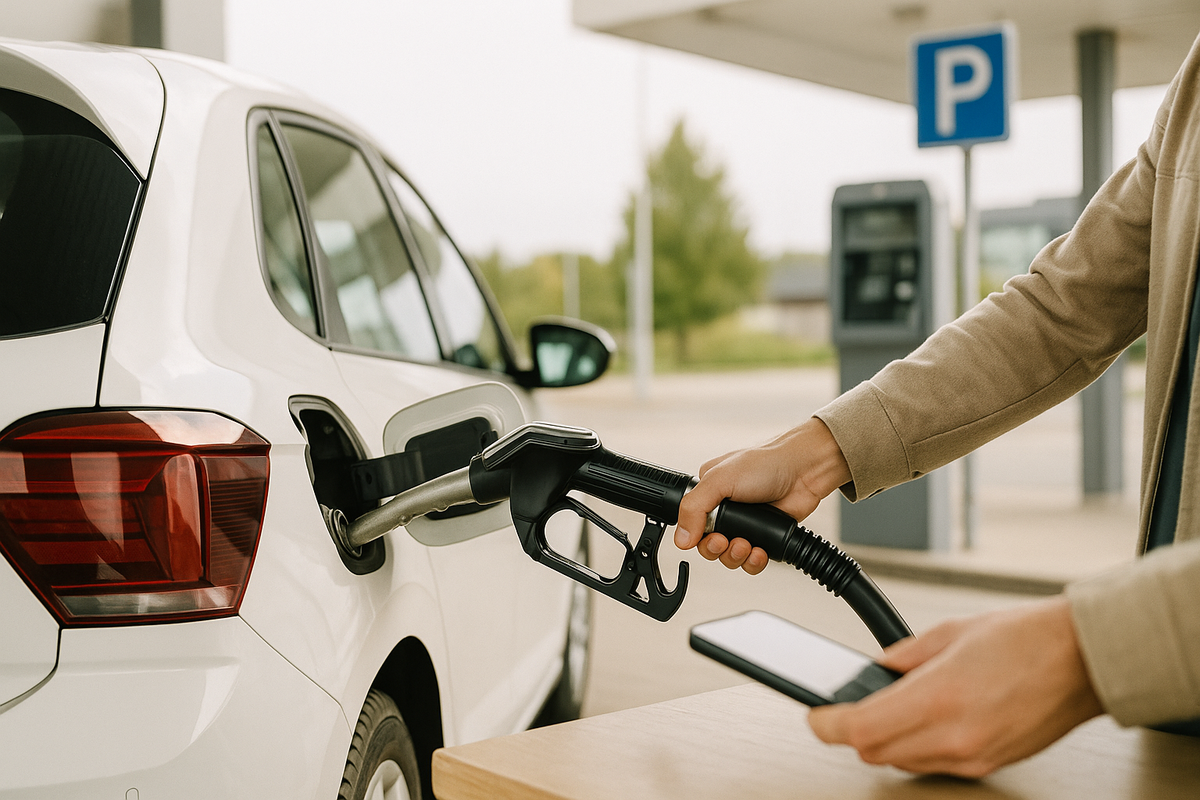
Over 7–10 days, operational costs (fuel, bridges, parking) can easily catch up with the rental price itself, especially if you’re actively touring the country and crossing borders.
Fuel: what a 800–1,200 km “sports tour” costs
Current data on petrol prices in Denmark shows levels around 13.7–14.2 DKK per litre of E10 petrol, with diesel at a similar level.
Let’s take an example:
- Total distance over 7–10 days: 800–1,200 km;
- Average fuel consumption: 6.5 l/100 km (compact/mid-size car);
- Price per litre: 14 DKK.
Calculation:
- 800 km → 52 litres → ~730 DKK of fuel;
- 1,200 km → 78 litres → ~1,090 DKK of fuel.
So even with moderate driving, fuel adds ~700–1,100 DKK to a weekly budget.
Toll bridges: Storebælt and Øresund
For passenger cars, Danish motorways themselves are toll-free, but toll bridges are a different story – they hit your budget much harder than most continental highways.
- Storebælt (Great Belt Bridge)
- from 2025, a one-way crossing for a passenger car paying on site is about 230 DKK,
- with automatic payment (bizz/number plate) it’s around 200 DKK per crossing.
- Øresund Bridge (Denmark–Sweden)
- standard fare for a passenger car (up to 6 m) is ~510 DKK per crossing;
- with an ØresundGO contract it’s around 178 DKK per crossing (but there’s an annual fee of ~365 DKK).
If during your trip you cross Storebælt twice (there and back) and Øresund twice as well, without discounts that’s already (230×2) + (510×2) = 1,480 DKK just for bridges.
Parking: Copenhagen and other big cities
Parking in Copenhagen is a separate budget line. The city is divided into zones (red, green, blue, yellow), and as of 2025 tariffs have increased significantly:
- red/green zones – ~44 DKK/hour;
- blue – ~26 DKK/hour;
- yellow – ~16 DKK/hour;
- in the evening (18:00–23:00) there is a unified rate of about 17 DKK/hour, at night (23:00–08:00) around 6 DKK/hour.
Example: you come into central Copenhagen 3–4 times in the evening for about 3 hours; even at the evening rate that’s 3 hours × 17 DKK × 3–4 days = 153–204 DKK just for “evening outings”.
If you park in red/green zones during the day, daily parking can easily add 150–300 DKK per day.
📊 Real-Life Case: How Much a Car Costs for 7–10 Days for an Active Team
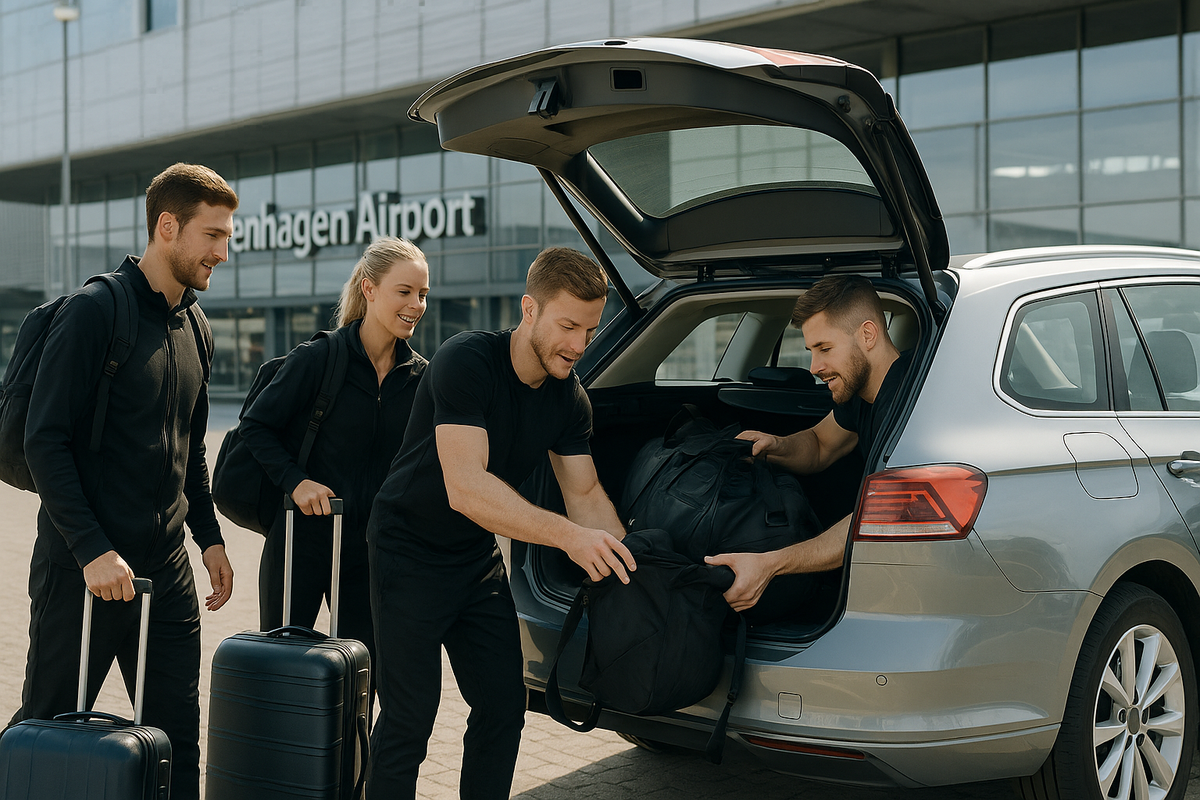
Let’s pull everything together into one sample bill.
- 3–4 people (team/sports group);
- Car class: mid-size/compact estate;
- Duration: 9 days (a typical “week + weekend”);
- Route: arrival in Copenhagen; trips to other towns/locations (training sessions, competitions); one Storebælt crossing there and back; 2–3 evenings in Copenhagen; car drop-off at the airport.
📊 Approximate cost breakdown (DKK)
| 📊 Item | 💰 Approximate total for 9 days |
|---|---|
| 📌 Car rental (mid-size, ~600 DKK/day) | ~5 400 DKK |
| 📌 Extra insurance (reduced excess, ~120 DKK/day) | ~1 080 DKK |
| 📌 Fuel (1 000–1 200 km) | ~900–1 100 DKK |
| 📌 Storebælt Bridge (round trip, no discount) | ~460 DKK |
| 📌 Parking (3–4 evenings in Copenhagen + 2 day trips) | ~500–800 DKK |
| 📌 Second driver / extra options (approx.) | ~300–600 DKK |
| 📌 TOTAL approx. | ~8 600–9 800 DKK |
Even without Øresund, without overpaying for a large car class and without extreme mileage, the real bill for 9 days for an active team easily falls into the 8,500–10,000 DKK range (and that’s without fines, damage or other force majeure).
If you split this amount between 3–4 people, the per person transport cost becomes more reasonable – especially if the alternative would be complex logistics by train and bus with lots of gear.
💡 How to Optimize Costs and When Car Rental in Denmark Really Makes Sense

Cost-saving strategies without sacrificing comfort
- 🗓️ Book in advance and compare several rental companies and car classes, and look not only at price but also at conditions (mileage limits, excess, extra fees).
- 🚙 Choose a sensible car class: a compact or estate will usually cover all your needs, while you pay a steep premium for crossovers or minivans.
- 🧭 Plan your route to minimize empty mileage – stay closer to race venues, cluster trips together, and don’t drive back and forth across Storebælt or Øresund without a clear need.
- 🧮 Calculate bridge and parking costs in advance: sometimes it’s cheaper to park once on the city’s edge and use public transport than to pay for central parking every day.
- 👥 Share costs within your team/group: 4 people in one car make rental linearly cheaper per person compared to individual train tickets.
When rental is a justified “must have”
Renting a car in Denmark makes particular sense when:
- your team has many training sessions/competitions outside major cities;
- you’re carrying bikes, skis, bulky gear that is hard to manage on trains;
- race starts/finishes are late in the evening or early in the morning, making public transport schedules inconvenient;
- you have a flexible country-wide itinerary, not just a point-to-point commute between two cities.
When public transport is the better option
Public transport tends to win if:
- your base is in Copenhagen or another large city, and most activities are within the reach of S-trains/metro/regional trains;
- only 1–2 people are travelling, with minimal gear;
- your planned trips can be covered by train + local bus/shuttle (many races and events organize transfers).
💡 Golden rule: calculate first, then book.
If the 7–10 day car rental calculator gives you a total that’s not far from the combined cost of trains/buses + occasional taxis, but gives you more freedom and flexibility, renting a car is justified. If the car eats up your budget while you spend half your time in Copenhagen, you’re usually better off investing in comfortable rail travel instead.
❓FAQ
✅ Once you factor in insurance, fuel, parking and at least one toll bridge, the total bill usually ends up in the 8,000–10,000+ DKK range per car.
✅ For intensive use and valuable gear in the car, extra insurance is often worth it because it protects you from a large one-off excess payment.
✅ With 800–1,200 km of driving and current fuel prices, you should budget roughly 700–1,100 DKK for fuel.
✅ One Storebælt round trip and one Øresund round trip without discounts will be roughly 1,400–1,600 DKK just in bridge tolls.
✅ A car is especially justified for teams and active travelers with frequent trips outside cities and lots of equipment, when public transport imposes too many constraints on timing and logistics.

0 comments
Log in to leave a comment