


🇩🇰🤝🇬🇱 Denmark and Greenland: A History of Their Relationship — with Names, Ships, Court Cases, and Arctic Twists
Greenland is part of the Kingdom of Denmark, yet it has its own political institutions, extensive autonomy, and a unique historical path: from mission and trade monopoly to modern Self-Government. If you follow the story as a chain of vivid episodes, it becomes clear why “Denmark and Greenland relations” keep returning to the public conversation again and again. 🌍❄️
This is a long, narrative-style historical explainer: real people, real places you can find on a map, famous documents, and lesser-known details that turn “dry dates” into a living story.
⚡ Greenland “Today” in One Minute
The Kingdom of Denmark consists of Denmark, Greenland, and the Faroe Islands. Greenland has its own elected parliament (Inatsisartut) and government (Naalakkersuisut). The modern framework is defined by the Act on Greenland Self-Government, in force since 21 June 2009—a date that is not accidental (we’ll return to it). 🗓️
The core mechanism is simple: some areas are already handled under Greenland’s self-rule, and other responsibilities can gradually be transferred to Greenland through procedures described in the Act. At the same time, there are areas that remain at the realm level for constitutional reasons.
🧊 Prologue: A Land Where People Learned to Live on the Edge of Ice
Greenland is often imagined as “an island of ice,” but historically it is more like a narrow coastal belt wrapped around a vast ice sheet—a corridor of life where wind, sea, animal migrations, and the ability to move decide everything. Early Greenlandic history is therefore a history of survival technologies and mobility.
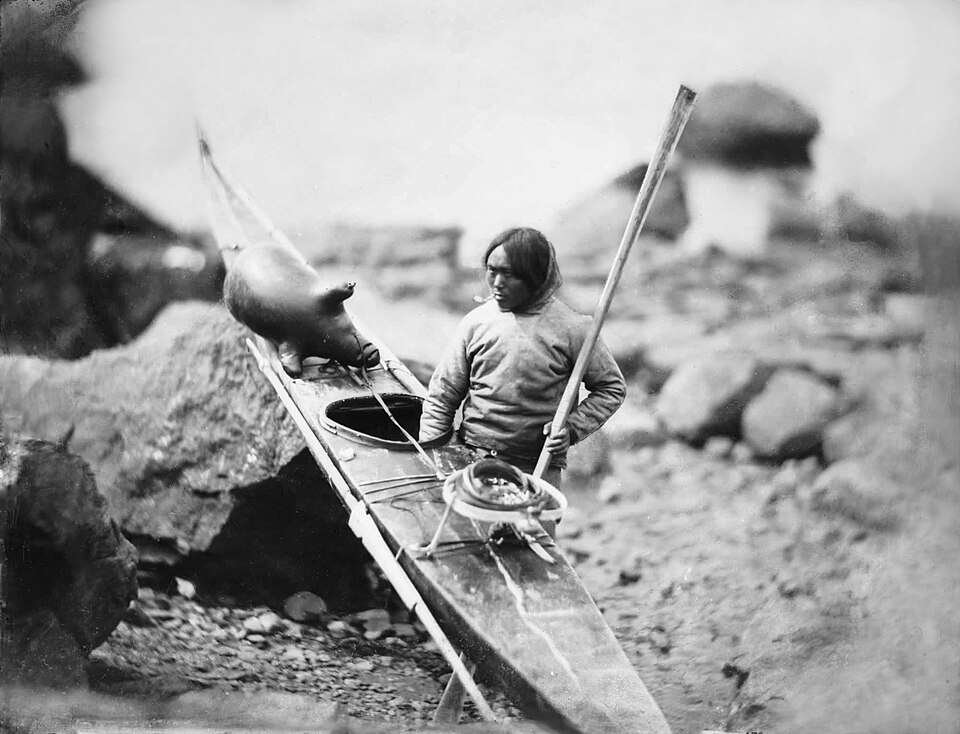
Archaeologists and historians describe Greenland as shaped by multiple waves of settlement. But one turning point matters especially for understanding the “human Greenland”: the arrival of the Thule people, ancestors of today’s Greenlandic Inuit. Their world is the kayak, the large skin boat for crossings, dog sleds, marine hunting, and living by seasons rather than by the clocks of far-off capitals. 🛶🐕🦺
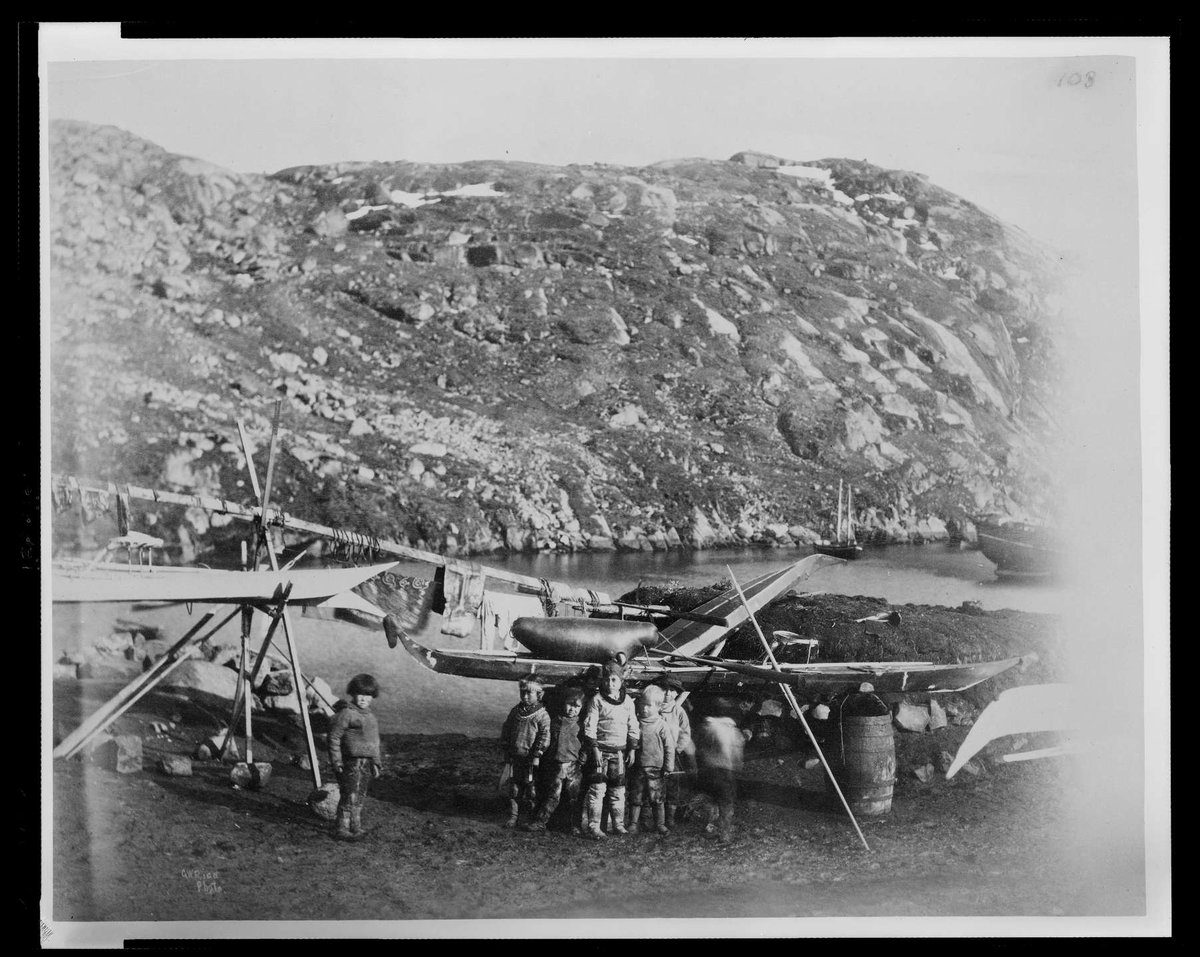
✨ Lesser-known fact: when Thule people spread across Greenland, the island was not an empty stage. Traces of earlier cultures remained—and in the southwest fjords, European (Norse) settlements had existed. Greenland was a crossroads where very different worlds could brush against each other—sometimes peacefully, sometimes tensely.
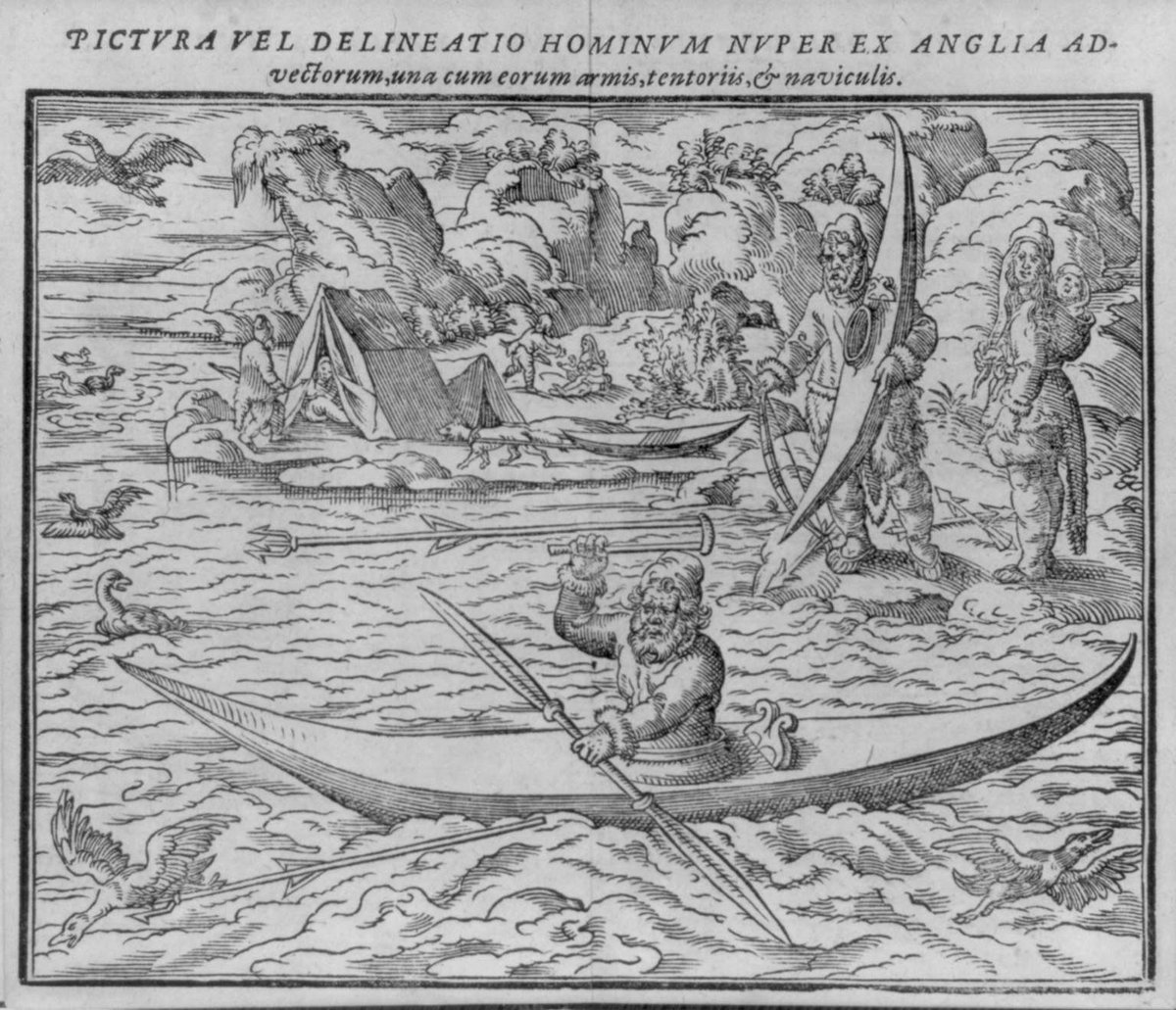
And it is on this stage, at the end of the 10th century, that a figure appears who becomes the start of “European Greenland.”
🛶 The Vikings: Erik the Red, “Green” Marketing, and Fjords That Became a Home
🌿 Erik the Red and a Name That Sounded Like a Promise
Erik the Red’s story begins not with discovery, but with exile. He leaves Iceland, explores the fjords of southern Greenland, then returns to Iceland to sell an idea: resettlement in Greenland—“the green land”—because, as the saga tradition puts it, people are more willing to go to a place with a pleasant name. In modern terms, legend becomes branding, and branding becomes migration. 📣
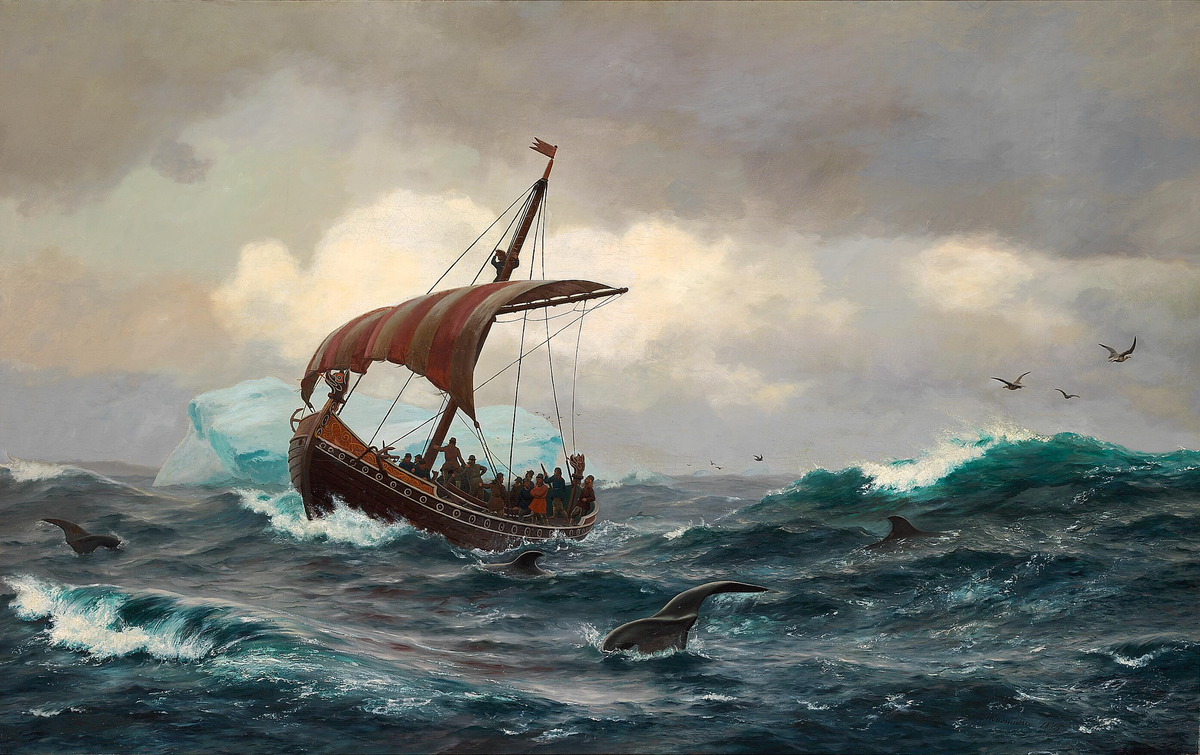
🚢 A Fleet into the Fog—Not All Ships Arrive
Saga tradition paints a cinematic picture: around two dozen ships set out from Iceland, but only part of the fleet reaches Greenland. This detail matters. Crossing the North Atlantic may look short on a map, but on water it is a gamble with storms, hunger, and cold that drains strength faster than any sword.
🏡 Brattahlíð and “Fjord Farming Greenland”
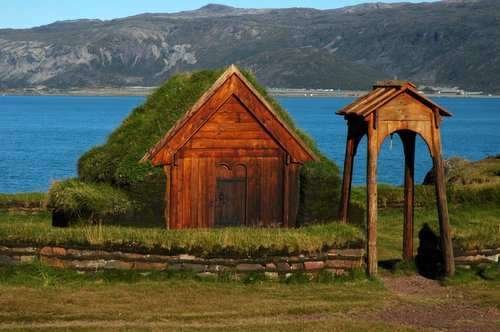
Erik establishes his base at Brattahlíð (in today’s Qassiarsuk) in the sheltered fjords of the south. There emerges something people rarely associate with Greenland: a fjord farming society—pastures, herds, homesteads, churches. Two main settlement areas form (often called the Eastern and Western Settlements), with administrative and church centers such as Gárðar. 🌾⛪
✨ Lesser-known fact: for medieval Europe, Greenland’s value was not “ice,” but walrus ivory and maritime goods—things that could become money and prestige. That’s one reason why even a far-off “edge land” still belonged to the North Atlantic economy of its era.
🕯️ The Last Scene: A Wedding at Hvalsey—and Silence After
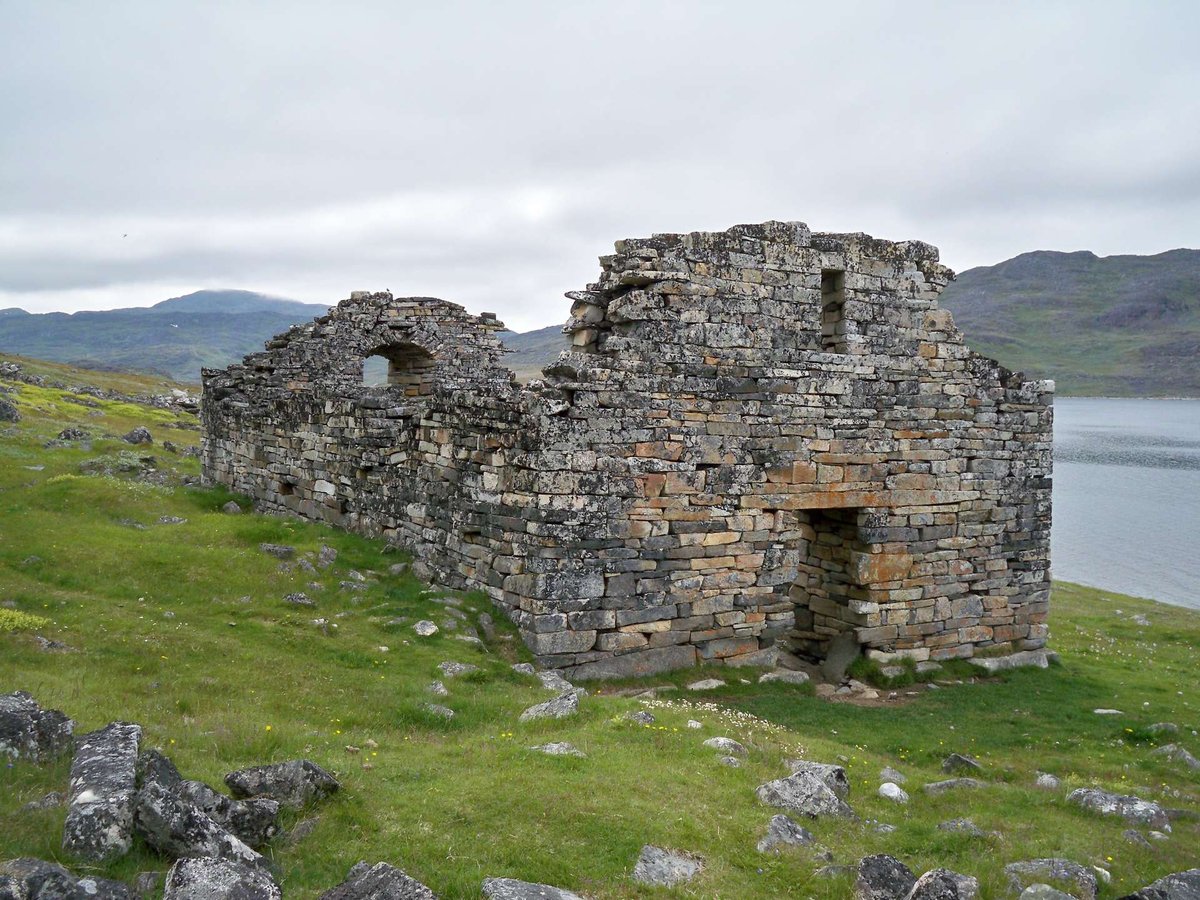
The most haunting documentary “frame” of Norse Greenland is not a battle but a wedding. In the ruins of Hvalsey Church (near modern Qaqortoq) in September 1408, Thorstein Olafsson and Sigrid Bjørnsdóttir are married. Later, letters describe the event—and it becomes one of the last dated written traces of Norse Greenland. Then: silence. The settlements fade from records.
Why they disappeared is a long story of its own. But for our story, the key point is this: when a stubborn missionary sets sail three centuries later, he will be searching for Norse descendants… and he will not find them.
⛵ 1721: Hans Egede and the Ship “Haabet” — How a New Era Began
🚢 Bergen, 2 May 1721: A Family Expedition
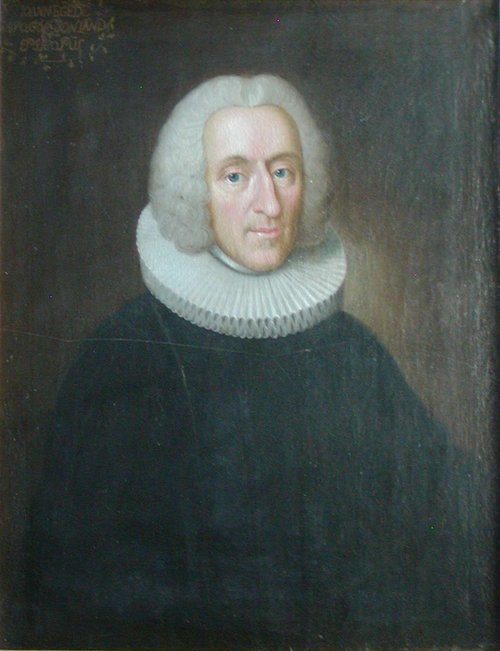
Hans Egede was a Lutheran priest and missionary who believed the “lost Norse of Greenland” could be found and brought back into the Christian fold. On 2 May 1721, he leaves Bergen aboard Haabet (“Hope”). With him travel his wife Gertrud Rask, their four children, and a group of colonists. In some accounts, additional supply vessels are mentioned—this was not a romantic solo voyage, but an attempt to establish a foothold.
On 3 July 1721, they enter Nuup Kangerlua (Nuuk Fjord). Seeking a place to survive the winter, they settle on Kangeq island. Thus is founded the “Hope Colony” (Haabets Colonie), and the island becomes known as Haabets Ø—“Hope Island.” You can trace the route by dates on a map: Bergen → West Greenland → the fjord by present-day Nuuk. 🧭
🧊 The Mission-Quest: “Find the Norse”—and Accept Reality
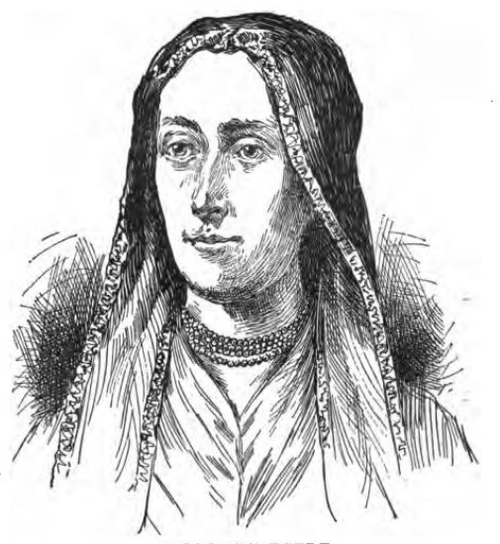
Egede searches for “old Norwegians” from the sagas—familiar signs, fragments of prayer, crosses on hills. Instead, he meets Kalaallit, Greenlandic Inuit. The mission changes. What begins is a contact story between two worlds—language, gestures, trade, and the difficult work of translation.
✨ A human detail: popular stories describe how early missionaries repeatedly misunderstood words and meanings, and had to learn the hard way. There is even a well-known anecdote (often told humorously) about how the phrase “daily bread” in the Lord’s Prayer could not be communicated without adapting to local realities. Whether or not every version is literally true, the point is real: Arctic mission work was, first of all, a struggle against misunderstanding.
🏙️ 1728: Godthåb Is Founded—Future Nuuk
The first settlement sites were vulnerable. In 1728, Godthåb (“Good Hope”) is established—later Nuuk, Greenland’s future capital. From this point, the Danish-Greenlandic line becomes continuous: administration, supply routes, trade structures, and mission networks form the “skeleton” of relations for centuries.
🌫️ 1733–1736: Smallpox, Loss, and a Turning Point
Egede’s story is not only “he founded a town.” In 1733, smallpox reaches Greenland. For local communities, it becomes a disaster. For Egede, it is a moral shock—an awful sense that the mission brings pain along with hope. In 1735, Gertrud Rask dies. In June 1736, Egede leaves Greenland—exhausted and grief-stricken.
But the story does not end. It shifts to the next generation.
📖 “Greenland Speaks”: Poul Egede and the First Major Texts
Egede’s sons continue the work. Poul (Paul) Egede becomes especially important as a language mediator: he helps build vocabulary and translations, and the Greenlandic written tradition begins to take a more systematic shape. Whatever one thinks about the mission’s legacy, this layer—language and texts—matters for how Greenland later defines itself.
And then comes the next big turn: Denmark makes Greenland not only a mission field, but a closed economic system.
🚪 1776: The “Closed Island” and the Monopoly That Shaped Daily Life
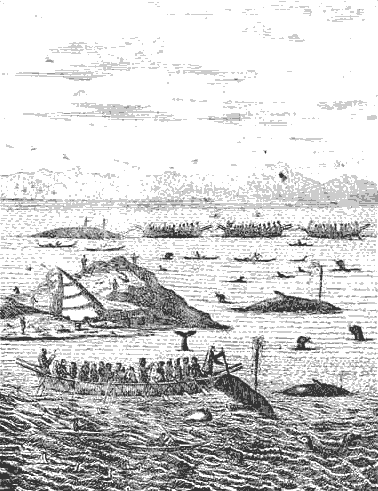
In the late 18th century, Copenhagen embraces a governing idea: Greenland must be shielded from outside influence and run through monopolized trade. From around 1776, Greenland becomes, in many ways, a “closed country”: foreign access is restricted, trade is controlled, and contact with the wider world passes through narrow administrative gates.
This is not mere bureaucracy. It is daily reality:
- who brings flour, iron, wood, tools—and when;
- what can be traded and at what price;
- which settlements grow and which remain “off the supply route.”
✨ Lesser-known fact: in such a system, power often looks less like a fortress and more like a warehouse and a ship. A supply captain could influence a settlement’s fate more than a distant official with papers.
This “closedness” will be felt even into the 20th century and will later become part of what reforms respond to. But first—Europe redraws its map, and Greenland’s fate gets fixed in a diplomatic clause.
📜 1814: The Treaty of Kiel — Why Greenland Stayed with Denmark
After the Napoleonic Wars, Denmark is pressured into a settlement. In January 1814, the Treaty of Kiel is signed. Denmark cedes Norway to Sweden—the Denmark-Norway union breaks. Yet a crucial exception remains: Greenland, Iceland, and the Faroe Islands stay with Denmark.
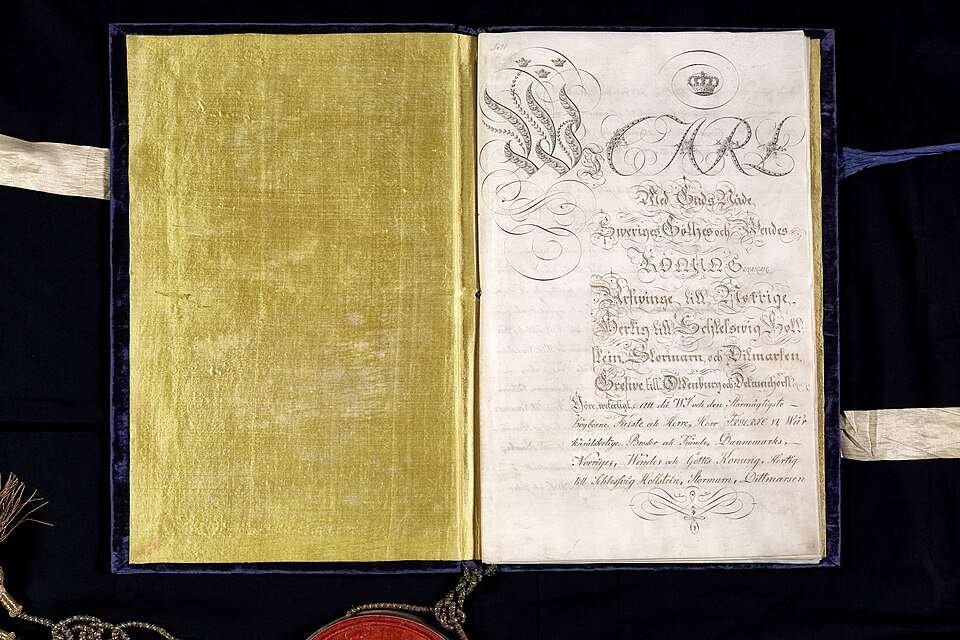
✨ Lesser-known fact: historians debate why this clause took this shape. One explanation is that North Atlantic territories seemed secondary compared to continental stakes. But that “secondary” status becomes decisive: it secures the Denmark–Greenland line for the next century—and sets the stage for a 20th-century dispute in court.
⚖️ 1919–1933: One Sentence, One Radio Station—and the Court Case That “Pinned the Map”
🗣️ 1919: The Ihlen Declaration—Diplomacy That Becomes Evidence
In 1919, Denmark seeks to assert sovereignty over all of Greenland. A detail later becomes famous: the Ihlen Declaration, associated with Norway’s foreign minister Nils Claus Ihlen, who reportedly said Denmark’s plans would “not meet difficulties” from Norway. In the moment, it sounds like polite reassurance. Years later, it becomes an argument in a legal battle.
✨ Lesser-known fact: in international disputes, “informal” statements can become heavy stones. The law loves paper—but sometimes it also recognizes the weight of a promise.
🛰️ East Greenland and a “Vacuum” That Was Not Empty
East Greenland in the early 20th century was sparsely populated, in places nearly without permanent settlements. That helped Norway’s logic: if a land is “no one’s,” one can plant a flag. Denmark argued the opposite: sovereignty is not only population density; it is systematic administration, monopoly governance, and international recognition.
📡 1931: Myggbukta and the Raised Flag
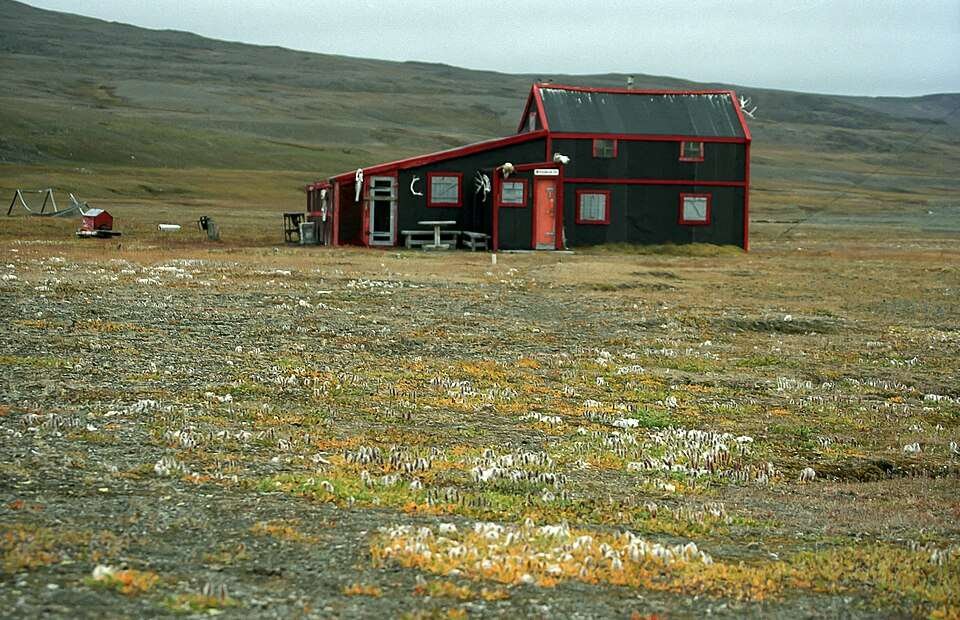
In summer 1931, a tiny point on the map—Myggbukta (“Mosquito Bay”)—becomes the “capital” of a historical episode. Norwegian trappers and Arctic operators raise a Norwegian flag and declare a section of East Greenland to be Norwegian. The story develops with theatrical clarity:
- a name appears: Erik the Red’s Land;
- boundaries are described between fjords (accounts often mention Carlsberg Fjord and Bessel Fjord);
- a “governor” is appointed: Helge Ingstad.
✨ Lesser-known fact: the episode was serious enough that echoes of “Norwegian Greenland” briefly resurfaced in later years, but the project was ultimately unsustainable.
⚖️ 5 April 1933: The Hague—The Legal Finale
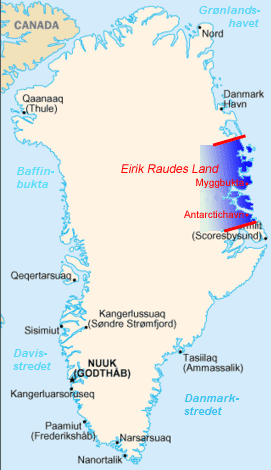
Denmark brings the dispute to the Permanent Court of International Justice (PCIJ) in The Hague. The court examines historical presence, administrative practice, and diplomatic commitments. The outcome in 1933 favors Denmark. Norway withdraws its claim. “Erik the Red’s Land” becomes a short but thunderous chapter where Arctic ambition collides with international law.
And just when the map seems settled, war enters the story—and Greenland becomes not only a legal question but a strategic node.
🌍 1940–1941: Denmark Occupied, a Council in Godhavn, and the Hull–Kauffmann Agreement
❄️ April 1940: Greenland Cut Off from Copenhagen
On 9 April 1940, Denmark is occupied. For Greenland, the break is almost physical: ocean, war, and disrupted governance. A striking scene follows—one recorded even in official wartime documents: the United Greenland Councils meet in Godhavn (today Qeqertarsuaq) and affirm loyalty to King Christian X, expressing hope for the island’s protection. 🏔️
✨ Lesser-known fact: a local meeting on a remote island ends up written into a major international legal document.
✍️ Washington, 9 April 1941: Signatures That Change Reality
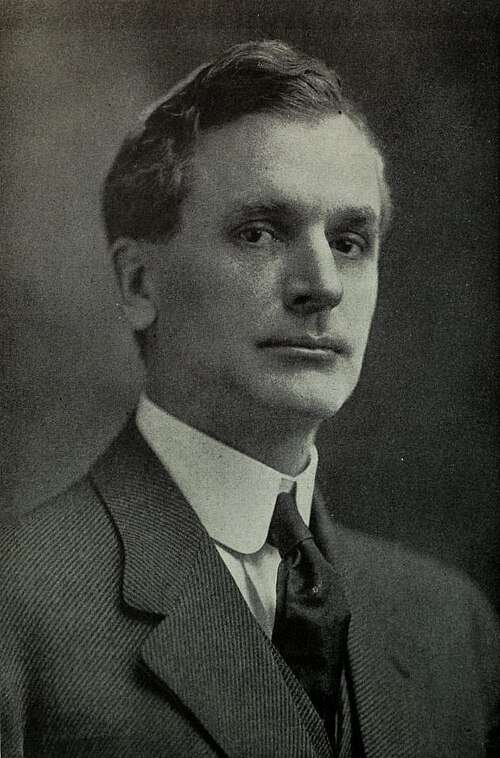
Exactly one year later, on 9 April 1941, the Agreement Relating to the Defense of Greenland is signed. The signatories are:
- Cordell Hull, U.S. Secretary of State, and
- Henrik de Kauffmann, Denmark’s envoy in Washington.
The agreement matters for three reasons:
- it explicitly recognizes Denmark’s sovereignty over Greenland;
- it grants the United States rights to establish and use defense facilities on the island while Denmark is unable to exercise normal powers due to occupation;
- it is recorded in a way that later generations can quote cleanly.
💎 A Wartime Mineral: Ivittuut and Cryolite
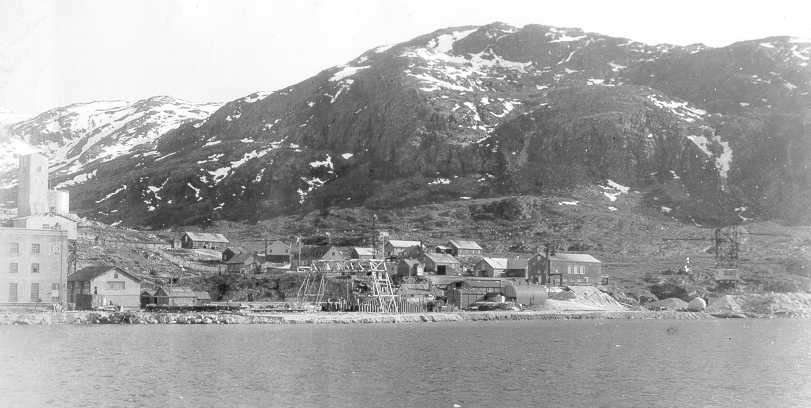
There is also a “resource layer” to the story. In southwest Greenland lies Ivittuut (Ivigtut), a mining town linked to cryolite, a mineral historically important in aluminum production. And aluminum, in wartime, means aircraft. Thus, a remote Arctic mine becomes a strategic point.
✨ Lesser-known fact: wartime Greenland is not only about bases and weather stations—it is also about materials and supply chains, where small Arctic dots suddenly matter.
After the war, the world shifts again. The Cold War turns the Arctic into a vast construction site.
🧊 1951–1968: Blue Jay, Thule (Pituffik), a “City Under Ice,” and the B-52 Crash
🚢 Summer 1951: Operation Blue Jay—A Convoy into North Star Bay
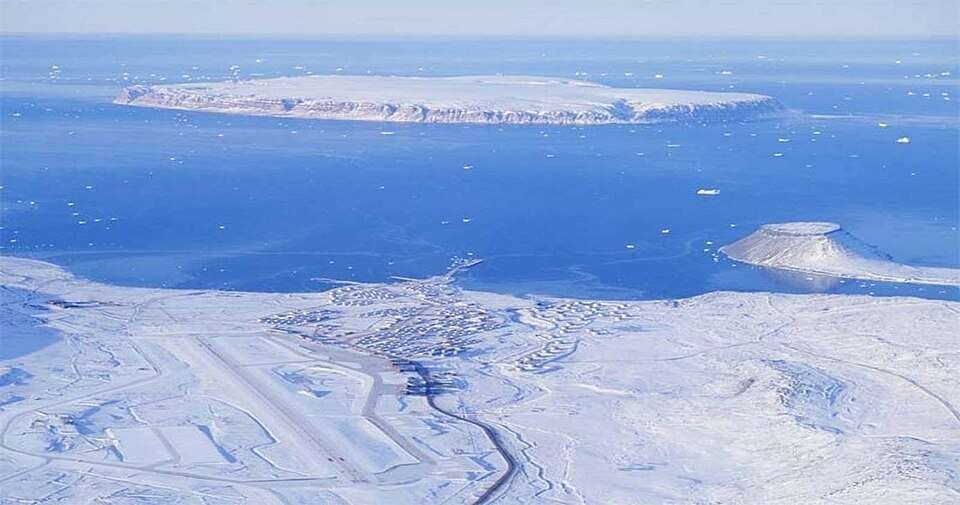
The building of the base near Thule / Pituffik proceeds under the codename Operation Blue Jay. The scale sounds unreal:
- around 120 shiploads,
- around 12,000 personnel,
- around 300,000 tons of cargo.
People live aboard ships until the first structures stand. Work runs around the clock—polar day makes night optional. Much of the airfield and core infrastructure is completed in roughly two months. 🏗️❄️
To keep buildings from sinking in permafrost, they are placed on piles; prefabricated panels are used. This is not romance—this is an engineering duel with ground that does not forgive mistakes.
✨ Lesser-known fact: there is a story that the construction surprised travelers—French explorer Jean Malaurie and his Inuit companion Kutukitsok reportedly stumbled upon the build-up in June 1951 while returning from research routes.
🧭 1953: Relocation and the “Long Echo”
Development of the base affects local communities. In 1953, relocation takes place connected to the base’s expansion—people are moved further north, toward Qaanaaq. Decades later, the episode gains legal and public afterlife under the name Hingitaq 53.
The key to understanding this chapter: in Arctic history, decisions rarely end with a single date. They echo through memory, law, and debates for generations.
🏚️ Camp Century: A “City Under Ice”
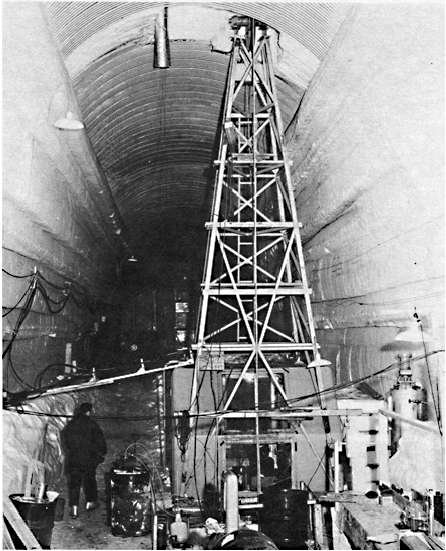
In the late 1950s, another almost science-fiction storyline appears: Camp Century, a base built within the ice sheet with tunnels and infrastructure. Later it is abandoned, and the ice begins to swallow it like a lost city returning to the earth. In the 21st century, it reemerges in research narratives—its structures become visible through radar data, producing the feeling of an Arctic Atlantis.
✨ Lesser-known fact: Camp Century is often linked in popular histories with Project Iceworm—ideas about using the ice sheet as infrastructure. Even without technical detail, the mere existence of such plans shows how experimental the Cold War Arctic could be.
☢️ January 1968: The B-52 Crash Near Thule
On 21 January 1968, a well-known Cold War incident occurs: a B-52 experiences an onboard fire, the crew ejects, and the aircraft crashes onto sea ice in North Star Bay near the base. The crash becomes part of a larger story about Arctic security, cleanup operations, and the reality that global tensions can leave literal traces on ice.
After such years, the need for a new legal and political framework grows. And 1953 is not only a year of relocation—it is also the year of a constitutional turn.
🏛️ 1953–1954: The Constitutional Turn—and a UN Decision Most Blogs Never Mention
📩 3 September 1953: A Letter to the United Nations
After Denmark’s constitutional changes of 5 June 1953, Denmark informs the UN that Greenland is to be treated as an integral part of the Danish state with equal constitutional status, and Denmark considers its reporting obligations under Chapter XI of the UN Charter (as for a non-self-governing territory) in relation to Greenland to have ended.
🏛️ 22 November 1954: A General Assembly Resolution That Closes One Chapter
The UN addresses the issue, and in a 1954 resolution notes several key points:
- that Greenlanders, through their elected representatives, freely exercised a right of self-determination in defining the new status;
- that Greenland freely decided to integrate into the Kingdom of Denmark on equal constitutional and administrative terms;
- and that it was appropriate to discontinue the transmission of information under Article 73(e) of the UN Charter with respect to Greenland.
✨ Lesser-known fact: the resolution emphasizes the role of Greenland’s own elected representatives in the process—an important detail showing it was not framed solely as “paperwork between capitals.”
But institutional autonomy, in the modern sense, still lies ahead. The next great turn is 1979.
🗳️ 1979: Home Rule — How Greenland Got Its Parliament and Its Political Everyday Life
📜 A Law in Copenhagen—and a Vote on the Island
On 29 November 1978, Denmark adopts the Home Rule Act. It does not become reality overnight—there must be preparation, electoral procedures, and a clear public mandate.
On 17 January 1979, Greenland holds a referendum: 70.1% vote in favor of expanded autonomy, with turnout around 63%. These are not just numbers—they are the political fuel that turns an idea into institutions.
In early 1979, the legal steps continue: Queen Margrethe II signs key acts, elections are held on 4 April, and on 1 May 1979, Home Rule takes effect. 🗳️
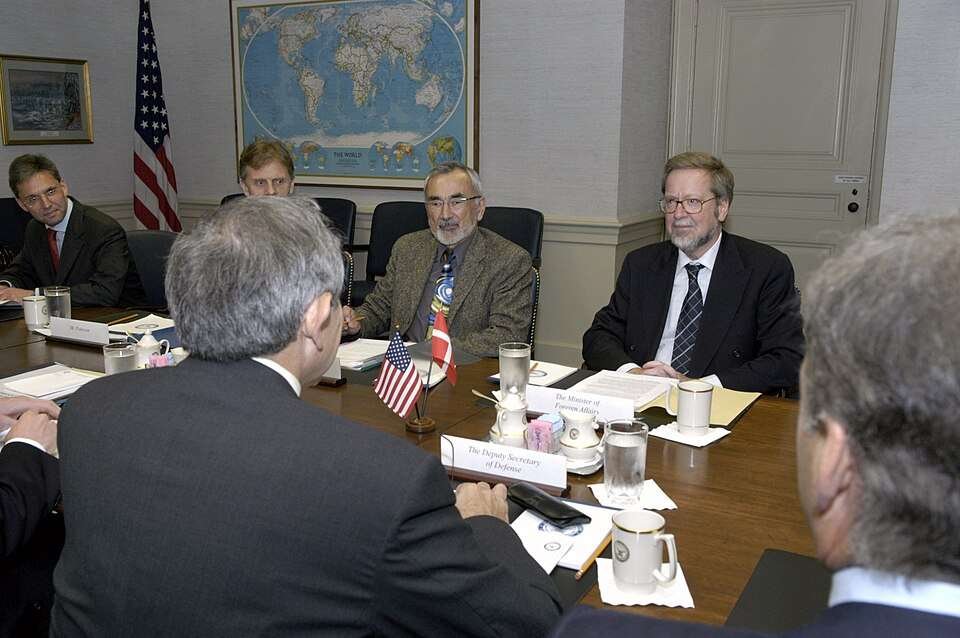
🏛️ Inatsisartut (then Landsting) and the First Decisions
A parliament is established—often called Landsting in Danish tradition, and Inatsisartut in Greenlandic. From this point, Greenland’s politics becomes “everyday”: budgets, education, healthcare, fisheries, local laws. What used to be a letter to Copenhagen becomes debate in Nuuk.
✨ Lesser-known fact: early autonomy often grows alongside symbols: the national day, flag, and calendar markers become part of the language of self-rule. Institutions first—then the visible signs of identity.
👤 Jonathan Motzfeldt and the “First Wave”
Names matter. One of the most recognizable leaders of early Home Rule is Jonathan Motzfeldt, associated with the party Siumut. In public memory, he belongs to the “first wave” when autonomy stopped being a concept and became day-to-day governance.
Soon after, Greenland begins reshaping not only internal administration but also its European framework.
🇪🇺 1982–1985: How Greenland Left the EEC — A Rare European Precedent
Denmark joined the European Communities in 1973, but Greenland’s support was weak. After Home Rule, the question returned in a new form—now Greenland could argue its case as a self-governing polity.
On 23 February 1982, Greenland holds a referendum: about 52% vote for withdrawal. In European history, this is a rare case: not “a country leaving a union,” but a territory inside a state changing its international regime through negotiations and treaty adjustments.
✨ Lesser-known fact: many analyses put one motive front and center: fisheries control. For Greenland, fish is not a sector—it is the backbone of the economy, and European rules felt too distant for Arctic realities.
After the referendum, complex legal work follows. The result is the so-called Greenland Treaty, and withdrawal takes effect in 1985. Greenland receives a status often described as OCT (Overseas Countries and Territories) in relation to the EU, while fisheries arrangements remain a special negotiation field.
🧩 2008–2009: Self-Government — A Modern “Constitution of Autonomy” and a Date Easy to Remember
🗳️ The Referendum of 25 November 2008
On 25 November 2008, Greenland votes on expanded self-government. Support rises higher than in 1979—around three quarters vote “yes,” with turnout around 72%. This becomes the political mandate for the 2009 act.
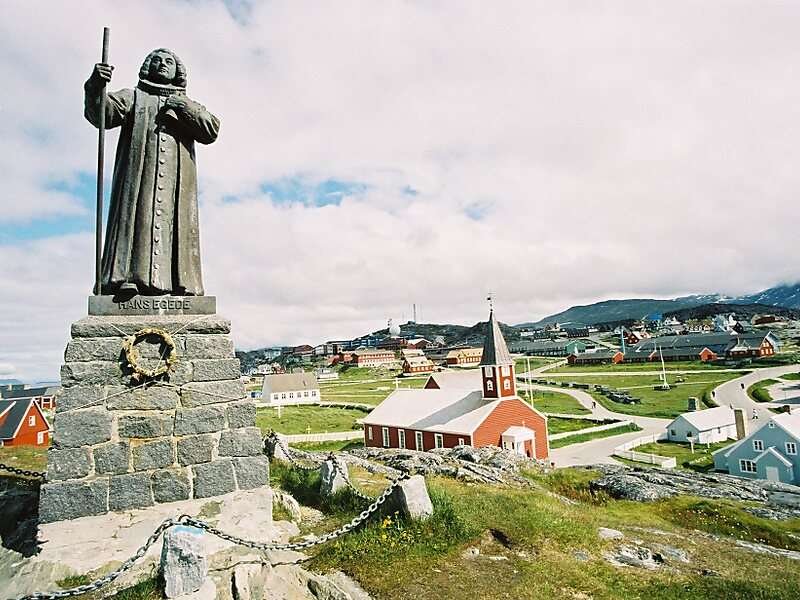
📜 The 2009 Act: Language, Powers, and a Procedural “Door”
The Self-Government framework does several things that explainers love to quote:
- it recognizes Greenlandic as the official language;
- it describes how additional responsibilities can be transferred to Greenland and under what procedures;
- it outlines a legal path for how a decision on independence would be made by Greenland’s people and then formalized through negotiations and approvals.
✨ Lesser-known fact: the act does not merely say “possible.” It lays out steps: decision by Greenland’s people → negotiations between governments → approval by Inatsisartut → referendum in Greenland → approval by Denmark’s parliament. This turns independence talk from slogans into procedure.
🗓️ 21 June 2009: A Symbolic Date
The finishing touch: the act enters into force on 21 June—Greenland’s National Day and the time of the summer solstice. If Home Rule gave Greenland institutions, Self-Government makes them more fully articulated—language, powers, and a legal architecture for future choices. 🌞❄️
🏙️ “Greenland in Denmark”: Traces of the Relationship Without Politics
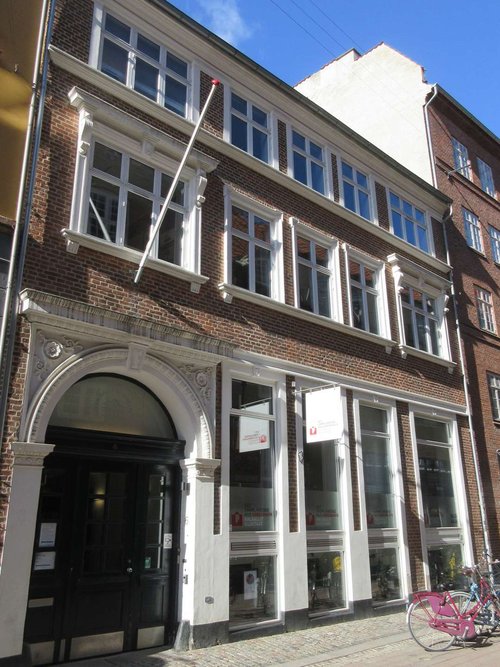
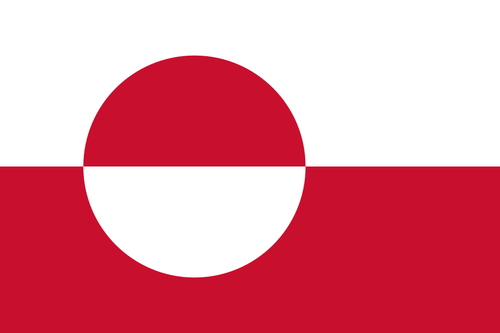
Even without opening the news, you can sense the Denmark–Greenland relationship in Copenhagen: cultural centers, Arctic museum collections, educational bridges. One key symbol is Kalaallit Illuutaat (Det Grønlandske Hus / The Greenlandic House) in Copenhagen—both a meeting place for Greenlanders in Denmark and a window into Greenlandic culture for visitors.
🎬 Final Thought: The Best Way to Read This Story
The history of Denmark–Greenland relations is not one straight line. It is layers:
- sea routes and logistics that decide settlement life;
- international law that can “pin a map”;
- war and the Cold War that turn the Arctic into a strategic node;
- and a gradual institutional evolution—Home Rule to Self-Government.
If you read it like a novel, the main twist is this: Greenland moved from a distant, tightly controlled territory to a modern self-governing society within the Kingdom—where history and law walk side by side like two tracks in snow. ❄️
❓ FAQ
Greenland is part of the Kingdom of Denmark, but it has Self-Government and its own institutions. The modern framework has been in force since 2009.
Because a major international court case over East Greenland was decided in The Hague, and the decision became a legal anchor in Greenland’s status history.
A defense agreement was signed in wartime conditions, recognizing Danish sovereignty and granting U.S. rights to defense facilities while Denmark was occupied.
Because constitutional changes and a UN decision formalized a new status formula and closed one chapter of Greenland’s international reporting regime.
Home Rule (1979) established durable autonomy with a parliament and local governance. Self-Government (2009) expanded autonomy and defined detailed procedures for transferring responsibilities, language status, and future decisions.
0 comments
Log in to leave a comment