


🎿 Cross-country skiing in Denmark: where to find trails after a snowfall.
When the first proper snow falls in Denmark, local chats almost explode: “Is there already a track in Hareskoven?”, “What about Rold Skov?”, “Are people skiing in Silkeborg or is it still too early?” Unlike Norway or Finland, there is no guaranteed season here – cross-country skiing works in short “windows”: a few days of good snow, and then back to plus temperatures and rain. That is why it is important not just to know pretty forest names, but to understand exactly where tracks appear, who prepares them, how to get there and when it actually makes sense to drag skis out of storage.
This article gives you a clear map of the key cross-country areas in Denmark, explains how “temporary” tracks work, covers rental options, car-free access and honestly compares the Danish experience with Norway and Finland.
🏞️ Cross-country skiing, Danish style: not a resort, but a “quick trip after snowfall”
Cross-country skiing in Denmark is not about big resorts with hundreds of kilometres of groomed tracks and lit loops every evening. It is more of a local sport and a way to squeeze the maximum out of a surprisingly good winter.
Typically, the pattern looks like this:
• 10–15 cm of snow falls.
• A local ski club or municipality sends out a snowmobile and prepares 2–10 km loops in the nearest forest.
• People from the region come for a couple of hours – some by car, some by train and bus.
• After a few days, plus temperatures and rain wash everything away.
So the main skill for a winter visitor in Denmark is not only to ski, but to react quickly: follow the forecast, check live track maps and be ready to jump into the forest at the very next opportunity.
🗺️ Where to look for tracks: key cross-country regions
In Denmark there are several “core” regions where almost every decent snowfall turns into cross-country tracks.
• North Zealand (Hareskoven, Gribskov, Dyrehaven). Forests north of Copenhagen, convenient if you live or stay in the capital. The terrain is gentle, with lots of wide forestry roads and tracks, loops are usually 2–5 km, sometimes several circuits. Perfect for families and beginners: you find your rhythm, do a loop, drink hot chocolate – and you are already back home.
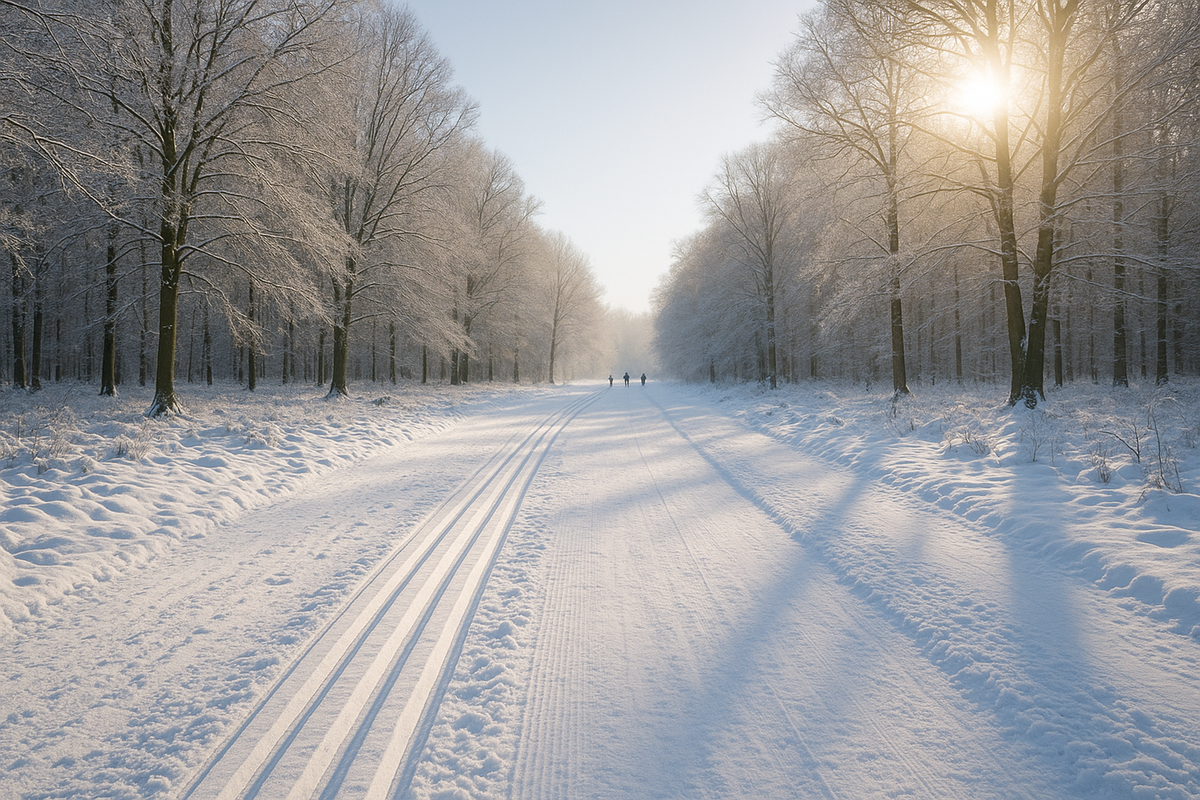
• Silkeborg lake district (Silkeborg, Søhøjlandet). A more hilly area in Central Jutland. Here you get more interesting tracks with climbs and descents, surrounded by water and forest. The format is closer to “real” Scandinavia: you can do 10–15 km and feel like you have had a proper adventure.
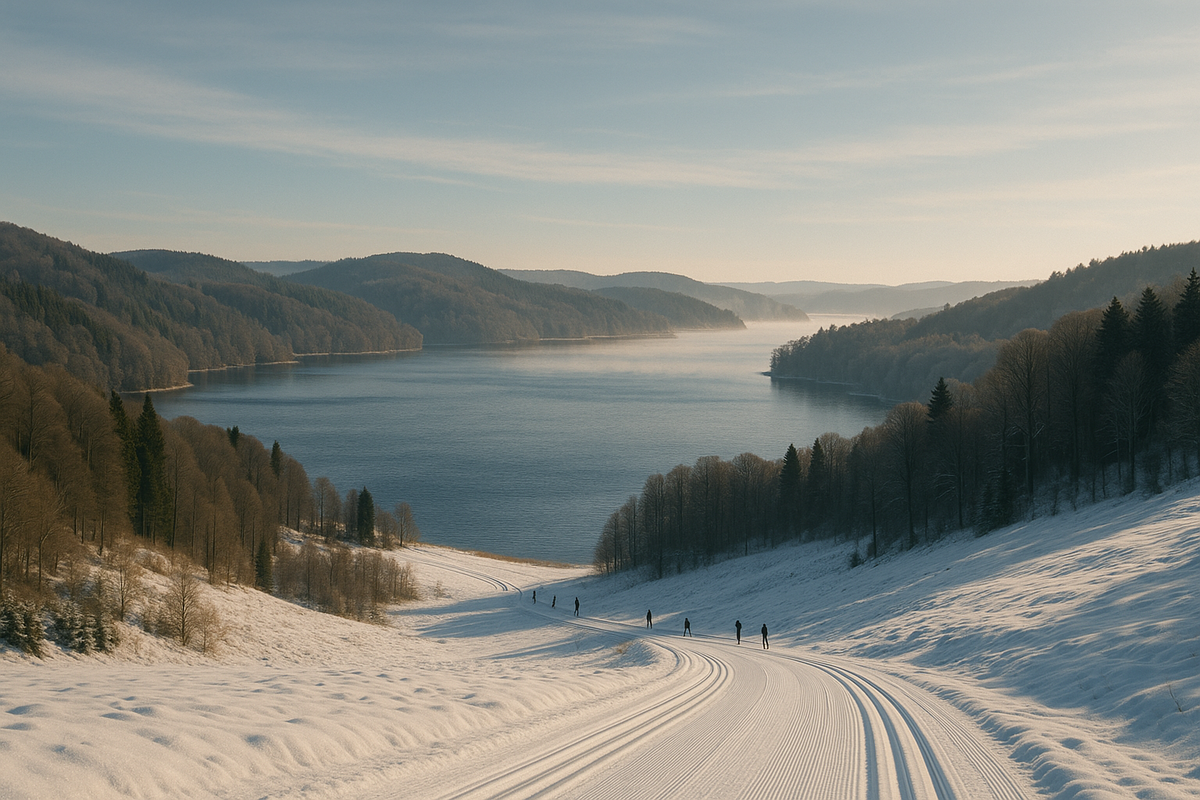
• Rold Skov and Rebild Bakker. A large forest and hill area in North Jutland. With good snow you get tracks of different difficulty levels: from calm forest loops to more demanding sections. It suits those who already feel confident on skis and want to get their heart rate up.
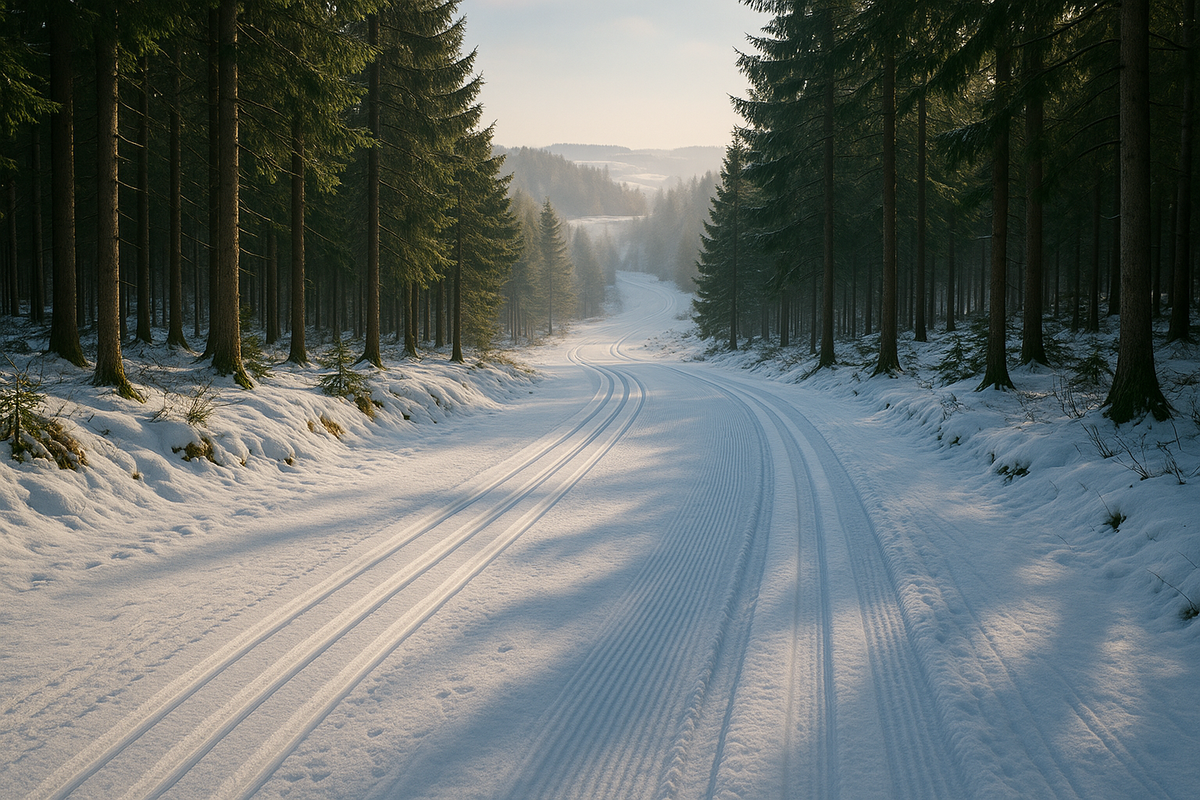
• Forests around Aarhus (Marselisborgskovene and other hills south and west of the city). After snowfall, loops for cross-country skis may also appear here – a good solution for those who live or stay in Aarhus and do not want to travel far.
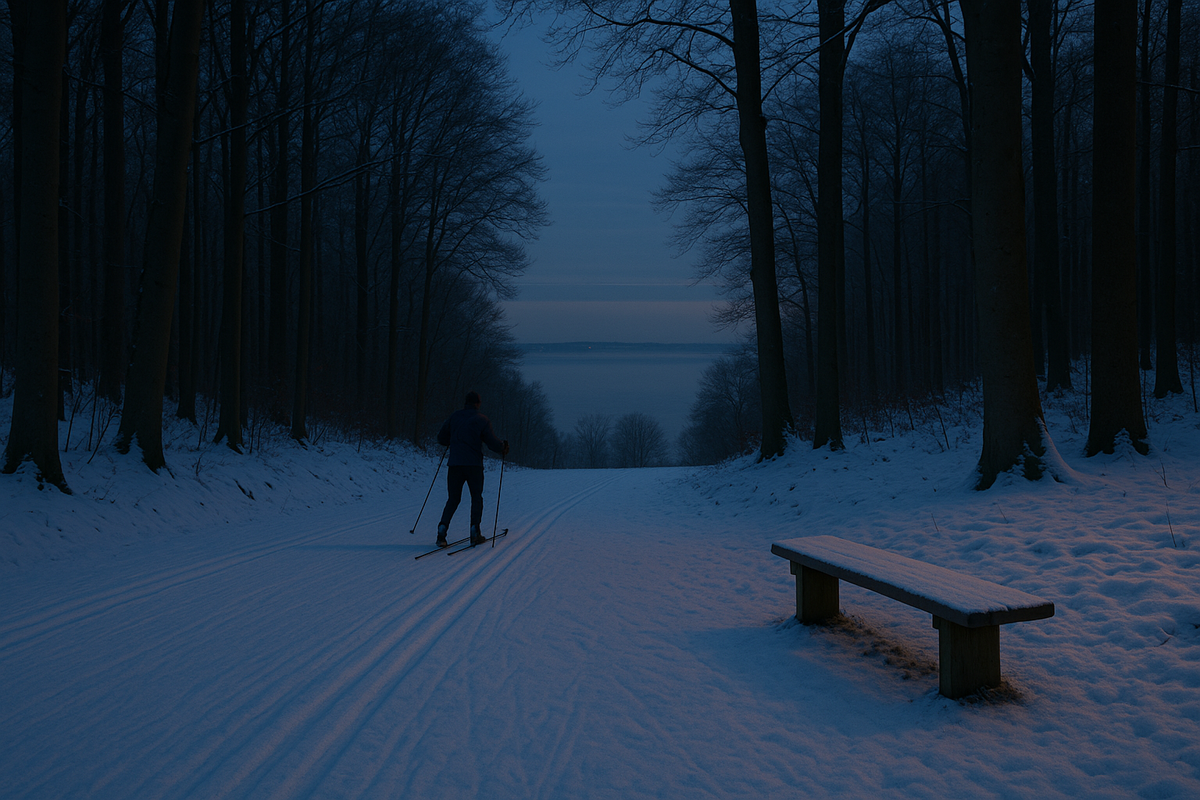
• Other local spots. In snowy winters small tracks appear in compact forests all over the country: in the suburbs of Odense, Aalborg and smaller Jutland towns. But this is already about “chasing” snow via local groups and news.
📌 Key regions for cross-country skiing in Denmark
| Region | Tracks | Level | Features |
|---|---|---|---|
| North Zealand (Hareskoven, Gribskov) |
|
|
|
| Silkeborg forests and lakes |
|
|
|
| Rold Skov and Rebild Bakker |
|
|
|
| Forests around Aarhus |
|
|
|
| Local forests and parks across the country |
|
|
|
❄️ How “temporary” tracks work and where to find fresh information
In Denmark cross-country tracks follow a simple rule: if there is snow, there is a track; if there is no snow, there is no track.
Normally the system works like this:
• the initiative comes from local ski clubs or sports associations;
• the club has a snowmobile or other equipment, which is sent out once there is enough snow on the ground (at least about 10–15 cm);
• on the compacted strip they lay one or two tracks – classic, and sometimes for skating as well;
• a map of the track and photos of current conditions appear on the club’s social media, website or in local news.
It is important to understand: nobody will “maintain” a track in plus temperatures and rain. If you see beautiful photos from three days ago and the forecast has already moved to +4 °C and rain, there is a high risk of arriving to a brown slushy mess.

🔁 Quick checklist after fresh snow
Algorithm: “It has snowed – I want to go skiing”
- Check the forecast for the next 2–3 days: will temperatures stay below zero or jump straight back above freezing.
- Check the websites and social media of nearby ski clubs and municipalities: have they announced track grooming.
- Look at fresh (today’s) photos and comments: is there ice under the snow, does it look too wet.
- Evaluate logistics: how long the return trip will take within daylight hours.
- Decide whether to go today, wait for the next snowfall or switch to another winter activity.
🎿 Rental equipment: where to get skis and what it costs
If you do not live in Denmark, buying a full set just for one short trip often does not make sense. It is usually easier and cheaper to hire everything on site.
Where to look for rental:
• sports shops in larger towns and cities (especially where there is a ski club nearby);
• activity centres close to major forests (Silkeborg, Rold Skov and others in good winters);
• sometimes ski clubs themselves rent out a limited number of sets for weekends.
What is usually included: classic cross-country skis with bindings, boots and poles. Sometimes you can also get a simple belt/strap for a small rucksack.
💸 Approximate prices for cross-country ski rental
| Format | What’s included | Price, DKK | Comment |
|---|---|---|---|
| Hourly hire in the city |
|
|
|
| Day hire near forest locations |
|
|
|
| Weekend hire |
|
|
|
| Buying a basic set |
|
|
|
🧳 Cross-country skiing without a car: what is realistic
The good news: some of the interesting forests can be reached by train and bus. The bad news: in winter you must take daylight and timing seriously.
Examples:
• Hareskoven. You can take the S-train from central Copenhagen to the nearest stations and then walk into the forest. If the snow is good and tracks start close to the stations, it is a perfect half-day car-free outing.
• Forests around Aarhus. Some loops start within reach of bus or light rail stops. You will need to walk a little, but there is no need to worry about parking.
• Silkeborg. In theory you can get there by train, but many trailheads still require transport or a taxi. This is more of a “stay in town and hire a car for the day” scenario than a fully car-free option.
When planning without a car, always:
• check the return timetable in daylight, not only morning departures;
• allow extra time to actually find the track in the forest (signage can be sparse);
• have a plan B if tracks are not groomed or turn out to be too wet.
🎒 Gear checklist for cross-country skiing in Denmark
Checklist: what to take for cross-country skiing
- Thermal base layer (top and bottom).
- Warm fleece or wool mid-layer.
- Wind- and water-resistant jacket and trousers.
- Thin but warm gloves for holding poles.
- Warm hat or buff; balaclava in strong wind.
- Thin wool socks, with a second layer if necessary.
- Small rucksack (10–20 l).
- Flask with a hot drink and snack.
- Head torch in case you are late.
- Charged phone in a warm inner pocket.
- Mini first-aid kit: plasters, wipes, pain relief.
🇩🇰 Denmark vs 🇳🇴 Norway and 🇫🇮 Finland: an honest comparison
To avoid false expectations, it helps to compare formats directly. In Norway and Finland there are whole regions where dozens of kilometres of tracks are groomed daily throughout winter. In Denmark everything depends on capricious weather and local initiatives.
📊 Comparing cross-country skiing: Denmark, Norway, Finland
| Criterion | Denmark | Norway | Finland |
|---|---|---|---|
| Snow reliability |
|
|
|
| Track length |
|
|
|
| Infrastructure |
|
|
|
| Best suited for |
|
|
|
In short: Denmark is not a country people fly to purely for a week of cross-country skiing. But if you already live here or visit in winter for a couple of weeks, it is perfectly realistic to catch good snow and enjoy one or two memorable forest outings. The main thing is not to expect Norwegian or Finnish scale, and to treat Danish tracks as a bonus to your winter trip.
❓FAQ
In practice you want at least 10–15 cm of snow. With less than that the snowmobile will scrape up soil and stones and your skis will suffer. The final decision is always made by the local club – they know the terrain and ground conditions.
In theory yes, but it is physically much harder and not always safe: there may be stones, roots and ice under the snow. For a first trip it is much better to look for a prepared track.
If you have a light modern set and are checking in hold luggage anyway – you can. But for one or two outings it is often easier to hire a set locally and not worry about transport.
Sometimes local clubs install lighting on short sections, but you should not rely on full networks of lit trails as in Norway or Finland. Most tracks are intended for daytime use.
Look not only at the fact that “a track has been prepared”, but also at the date and time of the latest update, temperature and precipitation. If a day of plus temperatures and rain has passed since grooming, the quality will be much worse than on a frosty morning.
For a short outing you can use normal winter clothes based on layering: base layer, fleece, windproof shell. The main thing is to avoid heavy down jackets and jeans – they are too warm, restrict movement and dry very slowly after a fall.
Yes, especially the forests of North Zealand and simple loops near large cities. Short tracks, gentle terrain and the possibility to quickly return to town make the format comfortable for beginners.
Prepare a plan B in advance: walking trails in the same forests, sledging or tubing, ice skating, winter walks along the sea, sauna and vinterbadning. Then the lack of ski tracks will not turn your holiday into a disappointment.

0 comments
Log in to leave a comment